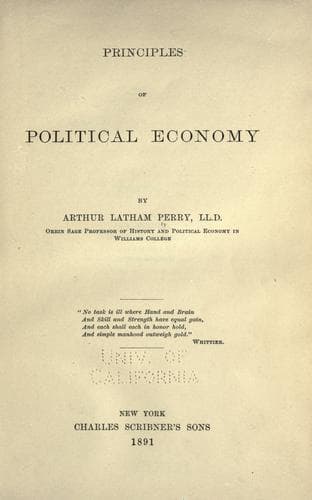
Principles of Political EconomyPerry, Arthur Latham
General
Principles of Political Economy
Perry, Arthur Latham
Economics
(e) The _mobility_ or immobility of laborers as a class acts powerfully
upon the Supply of them at any one time and place, and consequently
upon the rates of wages then and there. In some countries, notably in
the United States, laborers as a class move from place to place with
considerable facility under the action of Demand for personal services.
According to the Census of 1870, 7,500,000 of the native population
dwelt in other States than those in which they were born. Many of
these, doubtless, had left their native region to obtain more fertile
land, and many also to obtain more remunerative employment as laborers.
The native American, more than most other persons, is not only willing
to move from place to place in the hope of bettering his condition, but
is also willing to change his occupation from time to time in the same
hope. There is more freedom of movement locally, and less fixedness of
occupation on the part of laborers and others, in this country than in
any other industrial country. Even foreign immigrants here,--factory
operatives, miners, and other laborers,--seem to catch after a while
the spirit of the country in both these respects. There is one
considerable advantage in all this, namely, competition becomes more
uniform in all places, an unusual demand for laborers at any one point
is easily met, and wages neither rise so high nor fall so low at
special points as they otherwise would. But there are considerable
disadvantages in all this too, chiefly these, the services of laborers
floating locally or changing the kind of their labor can never become
so excellent as service more _steady_ in place and time; and,
especially, thorough apprenticeships, or whatever may be equivalent to
these, are held in too little esteem by public opinion, and are too
little requisite in order to obtain transient employment. To meet the
obvious pressure of these disadvantages, an admirable device is now
being hit on, namely, to introduce into our public schools something in
the way of "manual training" for the various trades. Public
institutions also, some of them on a great scale, as the Cooper Union
in New York and a more recent munificent foundation in Philadelphia,
have been established on purpose to train boys and girls both in eye
and hand to render skilfully those artisan services of the various
kinds which will always be in demand among men, and which have
certainly deteriorated among us owing in part to the disuse of the old
apprenticeship-system.
Public-domain text, read in full here on John Shaqi.
Reviews
Reviews
No reviews yet
Be the first to share your thoughts on this work.
Elsewhere in the archive
Join the Discussion
Join the discussion
Sign in to leave a comment or review.
Sign InorCreate an account