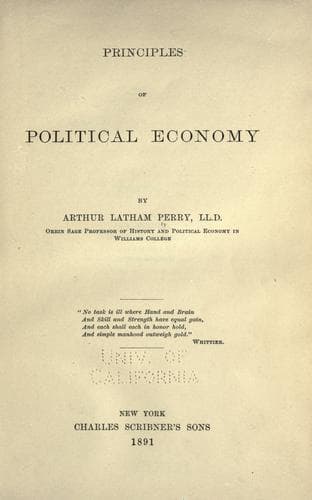
Principles of Political EconomyPerry, Arthur Latham
General
Principles of Political Economy
Perry, Arthur Latham
Economics
While the rates of freight per ton have decreased more than
three-quarters in less than one-quarter of a century in the case of
these 13 railroads on the whole average, the entire cost of the
operation of these roads in this interval of time has not been
diminished to any appreciable extent, as also stated by the same
Manual. The main item in all the operation-expenses of railroads is
the wages paid to the laborers of all grades; and the laborers are
quite as well paid now on these 13 roads as they were in 1865, proper
allowances being made for the changed and changing standards in the
national Money. If, on a broad view, railroad employees of all grades
have lost nothing as such in their wages in this interval; and the
general public, including these laborers and also the capitalists
concerned, have greatly gained, how can we account for the immensely
lessened freight-charges while the whole operation-expenses continue
substantially as before?
There is only one rational account to be given of this. And it is
trustworthy. All known facts jump with it, and nothing substantial can
be urged against it. The gains to the masses including the capitalists
and the laborers _have come out of the capitalists as such_. This is
apparent as well as real. Cost of Labor and Cost of Capital is the
whole cost. If the whole cost of moving one ton of freight from Boston
to Chicago is 3/4 less than it was 1/4 of a century ago, the cost of
the labor being the same at the two points of time, then the
conclusion is inevitable, that the _cost of the capital_ at the second
point is less than it was at the first point. With this conclusion all
facts agree. All the laborers connected with a railroad from highest
to lowest must be paid at any rate, or else the trains will certainly
cease to move, whether the stockholders receive any dividend or not on
their capital invested. The original _stock_--the capital that built
the roads--of many if not of most the railroads in the country, has
been annihilated, a new indebtedness in another form called _bonds_
having taken the place of it. Even the nominal dividends of
dividend-paying roads have declined in the interval from 10 or 8 to 5
or 4 _per centum_ in the general, that is, 50 _per centum_. It is
perfectly evident on every hand, that there is something in the nature
and progress of things, that makes for wages as contrasted with
profits: wages hold on and relatively enlarge, profits decline or go
out altogether.
Public-domain text, read in full here on John Shaqi.
Reviews
Reviews
No reviews yet
Be the first to share your thoughts on this work.
Elsewhere in the archive
Join the Discussion
Join the discussion
Sign in to leave a comment or review.
Sign InorCreate an account