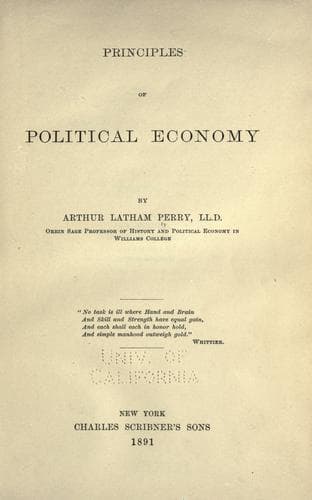
Principles of Political EconomyPerry, Arthur Latham
General
Principles of Political Economy
Perry, Arthur Latham
Economics
"Let every shoemaker stick to his last." Those who have looked into
it with any care have found, that Exchange in all its natural
outgoings is not answerable to these pulpit charges, nor is contrary
to the letter or spirit of the biblical precepts, but on the other
hand is in full harmony with the claims of Conscience and with all the
inbreathings and aspirations of Christianity.
(b) The second practical remedy for the labor-difficulties arising
from the want of thorough understanding by both parties of the real
nature of hired renderings of the second class, is fair _common
honesty_. More of an easily accessible intelligence, more of
penetration and separation as to social relations in general, meets
the first point; but quite as needful as this simple intellectual
process, is the still simpler moral habit of doing just what one has
agreed to do, without evasions and without diminutions. Labor
difficulties take their origin more often, perhaps, in some clouded
moral action of one of the parties, than in a clouded mental
apprehension. Men are too conscious as men of their own temptations,
to be lax in their pledged renderings and of their own shortcomings at
this point, not to be suspicious of each other as buyers and sellers,
for fear the party of the other part is about to withdraw something
either in quantity or quality of what he has promised to render; there
is almost always something or other to give color to such a suspicion,
and it grows by what it feeds on; frank explanations are not had at
the outset, and a good understanding is not come to, as it doubtless
might be in nine cases out of ten; and the little cloud, at first no
bigger than a man's hand, by and by becomes black and threatening, and
bursts at last in a strike or lock-out of large proportions. An open
honesty that is such and seems such, that is not beyond the aim and
reach of common men, that is taught in scores of forms in "Poor
Richard's Almanack," and that each man ever likes to meet with and so
ought ever to put forth, is in fact a preventive of conflicts between
laborers and employers, and would if properly manifested have
prevented multitudes of such actual conflicts. Here is the main,
almost the sole, point of contact between strict Ethics and the
Economics. What buyers and sellers, that is to say, the whole
practical world, needs, is not disquisitions on Morals from Press or
Pulpit, but an inner ear to hear the true click of Conscience, and the
quick and open answer in honest action.
Public-domain text, read in full here on John Shaqi.
Reviews
Reviews
No reviews yet
Be the first to share your thoughts on this work.
Elsewhere in the archive
Join the Discussion
Join the discussion
Sign in to leave a comment or review.
Sign InorCreate an account