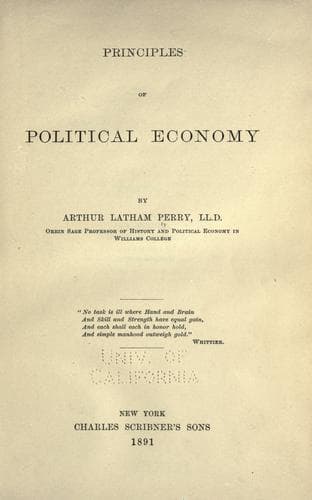
Principles of Political EconomyPerry, Arthur Latham
General
Principles of Political Economy
Perry, Arthur Latham
Economics
1. It is being dinned into the ears of the present generation, that
Government has large functions in the ongoings of business, that it
ought sometimes to interfere to better the rate of Wages, at least to
designate a minimum below which they shall not go, and that Government
should hold itself ready to undertake directly to carry on certain
branches of business under certain circumstances. This scheme goes
under the high-sounding name of _Nationalism_. Richard T. Ely,
Professor of Political Economy in Johns Hopkins University, is one of
the most prominent representatives at present of this school of
thought. In his Introduction to Political Economy just published
(1889), he lays down this principle: "_When for any class of business
it becomes necessary to abandon the principle of freedom in the
establishment of enterprises, this business should be entirely turned
over to Government, either local, state, or federal, according to the
nature of the undertaking._" He begins his book by attempting to
hammer in the "lesson" that as Civilization improves, coöperation
takes the place of individualism. The golden age of individualism, he
says, is among the wild tribes of Australia. They never coöperate with
each other in their economic efforts, or in anything else. No one
expects anything from his neighbor, and every one does unto others as
he thinks they would do to him. The life there is one prolonged scene
of selfishness and fear. But as civilization comes in, he says,
individualism goes out, and coöperation takes its place. The fine old
Bentham principle of _laissez faire_, which most English thinkers for
a century past have regarded as established forever in the nature of
man and in God's plans of providence and government, is gently tossed
by Dr. Ely into the wilds of Australian barbarism.
Public-domain text, read in full here on John Shaqi.
Reviews
Reviews
No reviews yet
Be the first to share your thoughts on this work.
Elsewhere in the archive
Join the Discussion
Join the discussion
Sign in to leave a comment or review.
Sign InorCreate an account