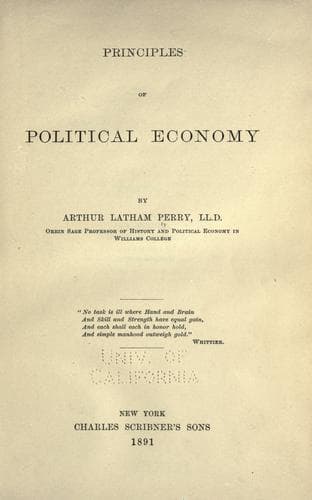
Principles of Political EconomyPerry, Arthur Latham
General
Principles of Political Economy
Perry, Arthur Latham
Economics
Like war too, strikes and lock-outs are wasteful and demoralizing to
both parties. Why should there be a resort to force to settle an
industrial dispute any more than to settle any other private dispute?
Will such a resort be long tolerated by public opinion in civilized
countries? The Legislature of Massachusetts in 1886 provided for a
State Board of Arbitration for the settlement of differences between
employers and employees. The statute was crude in some respects, and
the basis of it not very firmly fixed in the nature of things, but the
Bureau of Labor reports that it has been justified by the results in
its practical application during the short time of its operation. The
broad truth is, that the value of Commodities and the value of Credits
is now left to the safe action of Demand and Supply under free
competition in every country in Christendom: why should not the value
of Services be left to the same safe and inexorable action?
Governments gave up long ago all idea of regulating directly or
indirectly the prices of merchandise and the prices of commercial
claims of all kinds: will they not shortly give up also all idea of
regulating directly or indirectly the rates of Wages? They will. The
three kinds of things bought and sold are on an exact level in the
nature of things, so far as Government is concerned. Wages are
abundantly able to take care of themselves in the ordinary way, as
goods do, and stocks and bonds; and an enlightened Public Opinion is
fast coming to see, that a man's personal service rendered needs no
more the oversight of the State in its sale than his horse, or note of
hand at interest. Strikes, and lock-outs, and all extraordinary courts
or boards to settle quarrels between a labor-giver and a labor-taker
as such, since it is a case of ordinary buying and selling, are
foredoomed to pass out in the good time coming.
Towards this good end works strongly the common _futility_ of strikes
and lock-outs. Carroll D. Wright, chief of the Bureau of Labor in
Massachusetts, now the head of the National Bureau of Labor, in his
State Report for 1880, gave a succinct account of all strikes in that
State from their beginning in 1830. They were 159 in all, of which 109
were unsuccessful, 18 apparently successful, 16 compromised, 6 partly
successful, and 10 "result unknown." In Great Britain during the year
1878, there occurred 277 strikes, of which 256 were failures, 17 were
compromised, and only 4 were successful. The following table taken
from the Massachusetts Report of 1888, gives on a broad scale the
results of Strikes in the United States for six years:--
GENERAL SUMMARY OF STRIKES IN FIVE PRINCIPAL STATES FOR 1881-1886.
_Percentages._
Public-domain text, read in full here on John Shaqi.
Reviews
Reviews
No reviews yet
Be the first to share your thoughts on this work.
Elsewhere in the archive
Join the Discussion
Join the discussion
Sign in to leave a comment or review.
Sign InorCreate an account