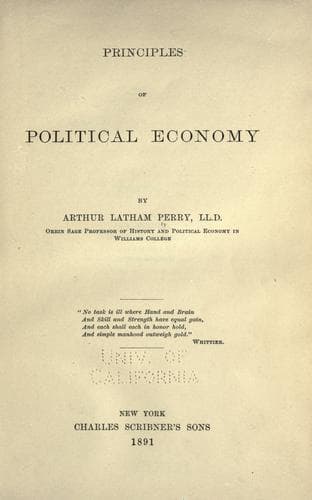
Principles of Political EconomyPerry, Arthur Latham
General
Principles of Political Economy
Perry, Arthur Latham
Economics
|Succeeded, | 54.16 | 35.28 | *51.05|49.44| 32.60 | 42.69 | *46.52|
|Succeeded | | | | | | | |
| partly, | 10.33 | 45.93 | *8.14| 8.87| 17.57 | 17.27 | *13.47|
|Failed, | 35.51 | 18.79 | *40.65|41.69| 49.83 | 40.04 | *39.95|
+--------------+-------+---------+-------+-----+--------+-------+-------+
* In 15 establishments the results were not ascertained.
3. The third popular remedy for low Wages, which has at least the
merit of being in the line of economical considerations, as the other
two are not, is "Co-operation." The interest in this proposed remedy
is much less both in Europe and in the United States than formerly,
owing to the failures that have mostly attended the attempts to put
the scheme into practice, although there have been some remarkable
successes also, particularly in England. The idea of Co-operation is
this, namely, that certain laborers within given classes combine of
their own accord, (1) _either to purchase their necessaries in common
and at wholesale, hence at cheaper rates because avoiding all profits
of the middlemen_; or (2), _more especially to engage in the joint
production of the commodities they are familiar with, the laborers
furnishing the capital also from their little hoards or borrowing it
on the strength of their individual or associated credit, managing the
business themselves, all being co-partners, and of course all sharing
pro rata the entire profits of the concern_.
Public-domain text, read in full here on John Shaqi.
Reviews
Reviews
No reviews yet
Be the first to share your thoughts on this work.
Elsewhere in the archive
Join the Discussion
Join the discussion
Sign in to leave a comment or review.
Sign InorCreate an account