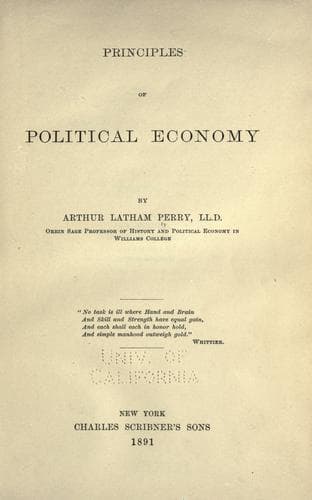
Principles of Political EconomyPerry, Arthur Latham
General
Principles of Political Economy
Perry, Arthur Latham
Economics
Besides the use of the term "Par of Exchange" in the broad commercial
sense in which we have now been examining it, as indicating the
substantial equality of international debts as between two countries
by the current prices of bills of exchange, there is another and
subordinate sense in which the phrase is employed, namely, as denoting
the _relative value_ of the coins of one nation in the coins of
another. Thus, our present gold dollar contains 23.22 grains of pure
gold; the English pound sterling contains 113.001 grains;
consequently, there are $4.8665 to the English pound; and this is the
"par of exchange" (in the secondary sense) between the United States
and Great Britain. Between the United States and France the "par" is
$1 to 5.18 francs, since the franc is 19.29 of our cents. An English
shilling equals 24.33 of our cents, the new German "mark" is 23.82
cents, and the new Scandinavian "crown" equals 26.78 cents.
_g._ Bank Cheques. In substance indeed and even in form, Cheques are
Bills of Exchange, but the two have such differing legal incidents,
and run so different a course towards extinguishment, that for our
purposes in this treatise they should be put under a separate
discussion. Bills of exchange are expressly drawn "at sight" or for a
day certain, when they become payable by the drawee: cheques _say_
nothing about "sight" or any future date, though they are _really_
drawn at sight, and are payable to bearer on demand: they must,
therefore, be presented for payment within the shortest reasonable
time (all things considered), in order that the holder may legally
claim against the drawer should the banker fail meantime: a cheque is
held as the payment of a debt until it be dishonored on presentation:
the banker bears the risk of the forgery of the drawer's name, unless
his mistake be made easier by the drawer's carelessness in drawing: a
cheque is not payable after the drawer's death. The parties to cheques
are the Drawer, who is a depositor with some banker; that banker thus
becomes the Drawee; and the person named in the cheque is the Payee,
who can indorse his own right over to another person by name or in
blank to bearer. When a cheque is drawn in this way by one _banker_
upon another, it is usually called in this country a _Draft_.
Public-domain text, read in full here on John Shaqi.
Reviews
Reviews
No reviews yet
Be the first to share your thoughts on this work.
Elsewhere in the archive
Join the Discussion
Join the discussion
Sign in to leave a comment or review.
Sign InorCreate an account