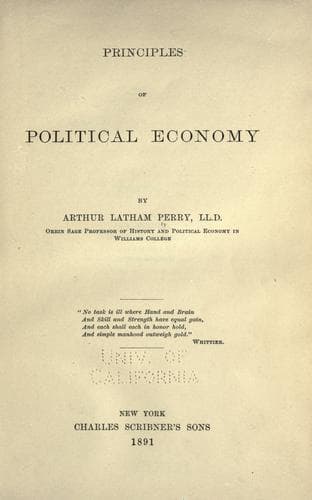
Principles of Political EconomyPerry, Arthur Latham
General
Principles of Political Economy
Perry, Arthur Latham
Economics
4. There are too some disadvantages inhering in Credit. This admitted
fact makes no valid argument against the use and extension of it;
because there are disadvantages connected with all human devices
whatever,--with all means contrived to reach earthly ends--and even a
child may discover many of these; some objections lie against
everything, and against everybody, and the practical question always
is, Which preponderates, the good or the evil? In respect to Credit
there can be no doubt, that the good outweighs the evil many fold;
still, in accordance with the purpose in this book of both writer and
readers to look on both sides of each significant point in Economics,
we will now give attention to the chief disadvantages inhering in the
nature of Credit.
(1) In the first place, when credit is much given by dealers to
ordinary retail buyers, the reverse results take place from those but
just now characterized as happening under bank credits, namely,
capital passes out from the hands of productive operators into hands
less able and less willing to use it in further production. Indeed, in
most such cases it ceases to be capital, and is expended in immediate
gratification. It is much easier for the average man of fair character
within the present customs of Society to "get trusted" than to pay "as
he goes." Such a man is even called "easy-going." He almost always
over-estimates his resources for the future, and under-estimates his
obligations at the present. It is always a disadvantage in the long
outlook for both parties when such men easily and largely "get
trusted." Let us take a sample case: when an industrious artisan or
efficient merchant has given credit for six months or a year to
dilatory customers, it is so much withdrawn for so long a time from
his active capital; and in order to make up his consequent loss of
profit to the average and expected rate, there must be an addition to
the prices of his wares sold to other parties; and, besides, some bad
debts belong to such a system, and there must be additional prices
somewhere to compensate for this; and thus the customers who pay
promptly bear a part of the burden of the delinquents, who at least do
not wholly escape, inasmuch as they ultimately (if they pay at all)
pay a price enhanced by their own delay. Thus, if the current and
expected profit on his capital be 12%, and the artisan or merchant
sells and gets returns four times a year on the average, something
less than 3% profit may be charged to each article on the average;
while if he only gets returns at the end of the year, at best 12% must
be put on everything at the average, and in reality considerably more,
because of the bad debts that stick like a burr to that way of doing
business. Hence the excellent maxim, "Quick sales and small profits."
Public-domain text, read in full here on John Shaqi.
Reviews
Reviews
No reviews yet
Be the first to share your thoughts on this work.
Elsewhere in the archive
Join the Discussion
Join the discussion
Sign in to leave a comment or review.
Sign InorCreate an account