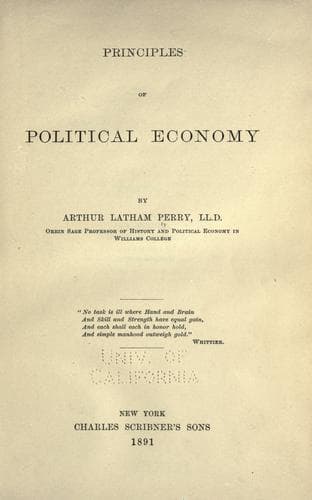
Principles of Political EconomyPerry, Arthur Latham
General
Principles of Political Economy
Perry, Arthur Latham
Economics
Without association with his fellow-men, there is no creature so
helpless, so unable to reach his true end, as is man; and therefore it
is, that the impulse to association is one of the strongest of our
natural impulses. Men come together, as it were by instinct, into
society; and, thus associating themselves together, it is soon
discovered, not only that there are various desires in the different
members of the community, which are now readily met by coöperation and
mutual exchange, but also that there are very different powers in the
different individuals in relation to those obstacles which are to be
surmounted. The tastes and aptitudes of different men are very
diverse. There is a great diversity in natural gifts. One man has
physical strength, another mechanical ingenuity, a third a
philosophical turn, and a fourth a bent and genius for traffic. Now,
then, Nature speaks in as loud a voice as she can utter, in favor of
such a degree of association and exchange as shall allow a free
development of these varying capacities, while they work upon the
obstacles to the gratification of men's wants, which lie appropriately
opposite to them.
Men must come together either locally or commercially, must learn each
other's wants, must compare with each other powers and tastes and
opportunities, must come to have some confidence in each other, and
then they will begin by rendering mutual services back and forth to
experience the better satisfactions and the new strength that
exchanges bring. Whatever improves the character of men, and thus
leads to greater confidence among them, will enlarge their commerce,
and knit closer and wider ties of association and production.
Neighborhood associations and productions soon create a surplus to be
exchanged for something else with other neighborhoods; parts of single
nations however remote from each other find a relative diversity of
advantage and an increasing profit in connecting themselves by the
ties of trade; and the separate nations learn, though late, that they
are only one great family for the grand ends of production and
progress. Even within the single nation, there is a strong tendency
for particular trades to localize themselves in one spot, as for
instance, the manufacture of skin gloves has centered itself for the
United States in Gloversville, N. Y.; and so in the great cities that
are centres of distribution, for example, the wholesale grocers of St.
Paul are on one street, the dry goods houses of Boston are in close
proximity, and the booksellers of New York are tending towards each
other in place.
Public-domain text, read in full here on John Shaqi.
Reviews
Reviews
No reviews yet
Be the first to share your thoughts on this work.
Elsewhere in the archive
Join the Discussion
Join the discussion
Sign in to leave a comment or review.
Sign InorCreate an account