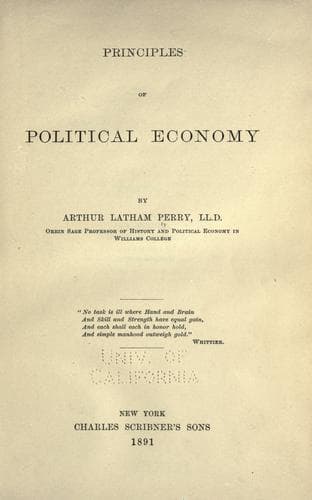
Principles of Political EconomyPerry, Arthur Latham
General
Principles of Political Economy
Perry, Arthur Latham
Economics
The ingenuity of Hargreaves, Arkwright, and Crompton had been
exercised to provide the weaver with yarn, and had now indeed provided
him with more yarn than he could use; the spinster had beaten the
weaver, just as the weaver had previously beaten the spinster; and the
making of cotton cloth seemed likely to continue sluggish, because the
yarn could not be woven any faster than a skilled workman could weave
it with Kay's improved fly-shuttle. In the summer of 1784, a Kentish
clergyman named Edmund Cartwright, being in conversation with some
Manchester gentlemen, one of whom observed that, "as soon as
Arkwright's patent expired so many mills would be erected and so much
cotton spun that hands would never be found to weave it," replied,
"Arkwright must then set his wits to work to invent a weaving-mill."
Notwithstanding the unanimous opinion expressed by the Manchester
gentlemen, that such a weaving-machine was wholly impracticable, the
clergyman himself within three years had invented and brought into
successful operation the "_power-loom_." Subsequent inventors improved
the idea which Cartwright originated, and before 1834 there were not
less than 100,000 power-looms at work in Great Britain alone.[3]
Substantially the same machinery invented for carding and spinning and
weaving cotton was very shortly and successfully applied to the
carding and spinning and weaving of wool, because the wisdom of Nature
imparted to them both the same sort of tenacity of fibre, the same
capacity in that fibre to be spun into a thread of indefinite length
by means of the little loops or kinks easily interlocking contiguous
fibres into a single thread, which two obvious resemblances gave an
identical name to the animal and vegetable products otherwise so
different from each other.
The spirit of Invention, one of the chief conditions in the production
of material commodities, thus simply illustrated along the line of a
single manufacture, may serve us for a sample of similar improvements
taken and taking place in scores upon scores of other lines of effort
and production. The principle is the same in all cases past and
present and still to come, namely this, to throw the strain from the
mind and muscles of men upon the forces and agencies of free Nature,
with which the world around us is crowded in our behalf, and which are
waiting to slave in the service of mankind without rest and without
fatigue,--without money and without price.
Public-domain text, read in full here on John Shaqi.
Reviews
Reviews
No reviews yet
Be the first to share your thoughts on this work.
Elsewhere in the archive
Join the Discussion
Join the discussion
Sign in to leave a comment or review.
Sign InorCreate an account