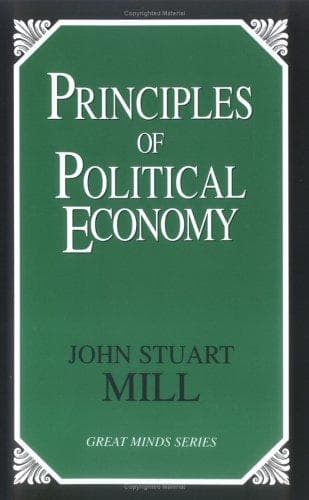
Principles of Political Economy: Abridged with Critical, Bibliographical, and Explanatory Notes, and a Sketch of the History of Political EconomyMill, John Stuart
PhilosophyPhilosophy
Principles of Political Economy: Abridged with Critical, Bibliographical, and Explanatory Notes, and a Sketch of the History of Political Economy
Mill, John Stuart
Economics
All the labor [not engaged in preparing materials] tends constantly and
strongly toward diminution, as the amount of production increases.
Manufactures are vastly more susceptible than agriculture of mechanical
improvements and contrivances for saving labor. In manufactures,
accordingly, the causes tending to increase the productiveness of industry
preponderate greatly over the one cause which tends to diminish it; and
the increase of production, called forth by the progress of society, takes
place, not at an increasing, but at a continually diminishing proportional
cost. This fact has manifested itself in the progressive fall of the
prices and values of almost every kind of manufactured goods during two
centuries past; a fall accelerated by the mechanical inventions of the
last seventy or eighty years, and susceptible of being prolonged and
extended beyond any limit which it would be safe to specify. The benefit
might even extend to the poorest class. The increased cheapness of
clothing and lodging might make up to them for the augmented cost of their
food.
There is, thus, no possible improvement in the arts of production which
does not in one or another mode exercise an antagonistic influence to the
law of diminishing return to agricultural labor. Nor is it only industrial
improvements which have this effect. Improvements in government, and
almost every kind of moral and social advancement, operate in the same
manner. We may say the same of improvements in education. The intelligence
of the workman is a most important element in the productiveness of labor.
The carefulness, economy, and general trustworthiness of laborers are as
important as their intelligence. Friendly relations and a community of
interest and feeling between laborers and employers are eminently so. In
the rich and idle classes, increased mental energy, more solid
instruction, and stronger feelings of conscience, public spirit, or
philanthropy, would qualify them to originate and promote the most
valuable improvements, both in the economical resources of their country
and in its institutions and customs.
§ 5. Law Holds True of Mining.
We must observe that what we have said of agriculture is true, with little
variation, of the other occupations which it represents; of all the arts
which extract materials from the globe. Mining industry, for example,
usually yields an increase of produce at a more than proportional increase
of expense.
Public-domain text, read in full here on John Shaqi.
Reviews
Reviews
No reviews yet
Be the first to share your thoughts on this work.
Elsewhere in the archive
Join the Discussion
Join the discussion
Sign in to leave a comment or review.
Sign InorCreate an account