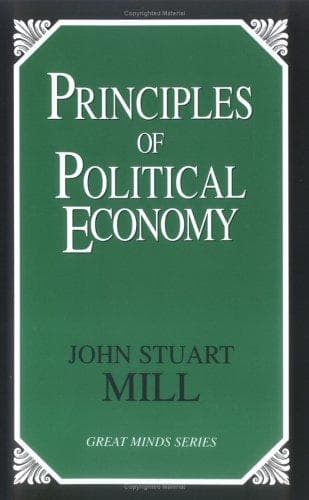
Principles of Political Economy: Abridged with Critical, Bibliographical, and Explanatory Notes, and a Sketch of the History of Political EconomyMill, John Stuart
PhilosophyPhilosophy
Principles of Political Economy: Abridged with Critical, Bibliographical, and Explanatory Notes, and a Sketch of the History of Political Economy
Mill, John Stuart
Economics
From the preceding exposition it appears that the limit to the increase of
production is twofold: from deficiency of capital, or of land. Production
comes to a pause, either because the effective desire of accumulation is
not sufficient to give rise to any further increase of capital, or
because, however disposed the possessors of surplus income may be to save
a portion of it, the limited land at the disposal of the community does
not permit additional capital to be employed with such a return as would
be an equivalent to them for their abstinence.
In countries where the principle of accumulation is as weak as it is in
the various nations of Asia, the desideratum economically considered is an
increase of industry, and of the effective desire of accumulation. The
means are, first, a better government: more complete security of property;
moderate taxes, and freedom from arbitrary exaction under the name of
taxes; a more permanent and more advantageous tenure of land, securing to
the cultivator as far as possible the undivided benefits of the industry,
skill, and economy he may exert. Secondly, improvement of the public
intelligence. Thirdly, the introduction of foreign arts, which raise the
returns derivable from additional capital to a rate corresponding to the
low strength of the desire of accumulation.
An excellent example of what might be done by this process is to
be seen under our very eyes in the present development of Mexico,
to which American capital and enterprise have been so prominently
drawn of late. All these proposed remedies, if put into use in
Mexico, would undoubtedly result in a striking increase of wealth.
§ 2. Even where the Desire to Accumulate is Strong, Population must be
Kept within the Limits of Population from Land.
But there are other countries, and England [and the United States are] at
the head of them, in which neither the spirit of industry nor the
effective desire of accumulation need any encouragement. In these
countries there would never be any deficiency of capital, if its increase
were never checked or brought to a stand by too great a diminution of its
returns. It is the tendency of the returns to a progressive diminution
which causes the increase of production to be often attended with a
deterioration in the condition of the producers; and this tendency, which
would in time put an end to increase of production altogether, is a result
of the necessary and inherent conditions of production from the land.
This, of course, is based on the supposition that no new lands,
such as those of the United States, can be opened for cultivation.
If there is no prohibition to the importation of cheaper food, new
and richer land in any part of the world, within reach of the
given country, is an influence which works against the tendency.
Yet the tendency, or economic law, is there all the same, forever
working.
Public-domain text, read in full here on John Shaqi.
Reviews
Reviews
No reviews yet
Be the first to share your thoughts on this work.
Elsewhere in the archive
Join the Discussion
Join the discussion
Sign in to leave a comment or review.
Sign InorCreate an account