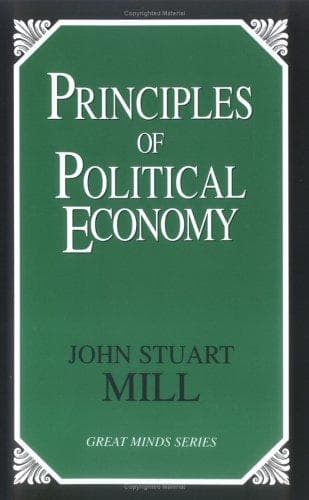
Principles of Political Economy: Abridged with Critical, Bibliographical, and Explanatory Notes, and a Sketch of the History of Political EconomyMill, John Stuart
PhilosophyPhilosophy
Principles of Political Economy: Abridged with Critical, Bibliographical, and Explanatory Notes, and a Sketch of the History of Political Economy
Mill, John Stuart
Economics
Ever since the great mechanical inventions of Watt, Arkwright, and their
contemporaries, the return to labor has probably increased as fast as the
population; and would even have outstripped it, if that very augmentation
of return had not called forth an additional portion of the inherent power
of multiplication in the human species. During the twenty or thirty years
last elapsed, so rapid has been the extension of improved processes of
agriculture [in England], that even the land yields a greater produce in
proportion to the labor employed; the average price of corn had become
decidedly lower, even before the repeal of the corn laws had so materially
lightened, for the time being, the pressure of population upon production.
But though improvement may during a certain space of time keep up with, or
even surpass, the actual increase of population, it assuredly never comes
up to the rate of increase of which population is capable: and nothing
could have prevented a general deterioration in the condition of the human
race, were it not that population has in fact been restrained. Had it been
restrained still more, and the same improvements taken place, there would
have been a larger dividend than there now is, for the nation or the
species at large. The new ground wrung from nature by the improvements
would not have been all tied up in the support of mere numbers. Though the
gross produce would not have been so great, there would have been a
greater produce per head of the population.
§ 3. Necessity of Restraining Population not superseded by Free Trade in
Food.
When the growth of numbers outstrips the progress of improvement, and a
country is driven to obtain the means of subsistence on terms more and
more unfavorable, by the inability of its land to meet additional demands
except on more onerous conditions, there are two expedients, by which it
may hope to mitigate that disagreeable necessity, even though no change
should take place in the habits of the people with respect to their rate
of increase. One of these expedients is the importation of food from
abroad. The other is emigration.
Public-domain text, read in full here on John Shaqi.
Reviews
Reviews
No reviews yet
Be the first to share your thoughts on this work.
Elsewhere in the archive
Join the Discussion
Join the discussion
Sign in to leave a comment or review.
Sign InorCreate an account