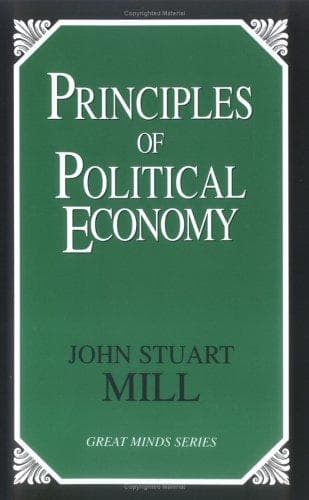
Principles of Political Economy: Abridged with Critical, Bibliographical, and Explanatory Notes, and a Sketch of the History of Political EconomyMill, John Stuart
PhilosophyPhilosophy
Principles of Political Economy: Abridged with Critical, Bibliographical, and Explanatory Notes, and a Sketch of the History of Political Economy
Mill, John Stuart
Economics
The extraordinary resources of the United States are scarcely
understood even by Americans. Chart No. XVIII (see Book IV, Chap.
III) may give some idea of the agricultural possibilities of our
land. It will be seen from this that the quantity of fertile land
in but one of our States—Texas—is greater than that of
Austria-Hungary.
But the countries which have at the same time cheap food and great
industrial prosperity are few, being only those in which the arts of
civilized life have been transferred full-grown to a rich and uncultivated
soil. Among old countries, those which are able to export food, are able
only because their industry is in a very backward state, because capital,
and hence population, have never increased sufficiently to make food rise
to a higher price. Such countries are Russia, Poland, and Hungary.
The law, therefore, of diminishing return to industry, whenever population
makes a more rapid progress than improvement, is not solely applicable to
countries which are fed from their own soil, but in substance applies
quite as much to those which are willing to draw their food from any
accessible quarter that can afford it cheapest.
§ 4. —Nor by Emigration.
Besides the importation of corn, there is another resource which can be
invoked by a nation whose increasing numbers press hard, not against their
capital, but against the productive capacity of their land: I mean
Emigration, especially in the form of Colonization. Of this remedy the
efficacy as far as it goes is real, since it consists in seeking elsewhere
those unoccupied tracts of fertile land which, if they existed at home,
would enable the demand of an increasing population to be met without any
falling off in the productiveness of labor. Accordingly, when the region
to be colonized is near at hand, and the habits and tastes of the people
sufficiently migratory, this remedy is completely effectual. The migration
from the older parts of the American Confederation to the new Territories,
which is to all intents and purposes colonization, is what enables
population to go on unchecked throughout the Union without having yet
diminished the return to industry, or increased the difficulty of earning
a subsistence.
How strictly true this is may be seen by examining the map given
in the last census returns,(142) showing the residence of the
natives of the State of New York. The greater or less frequency of
natives of New York, residing in other States, is shown by
different degrees of shading on the map. A large district westward
as far as the Mississippi shows a density of natives of New York
of from two to six to a square mile, and a lesser density from
Minnesota to Indian Territory, on the other side of the
Mississippi. The same is shown of other older States. The
explanation of the movement can not be anything else than the same
as that for the larger movement from Europe to America.
Public-domain text, read in full here on John Shaqi.
Reviews
Reviews
No reviews yet
Be the first to share your thoughts on this work.
Elsewhere in the archive
Join the Discussion
Join the discussion
Sign in to leave a comment or review.
Sign InorCreate an account