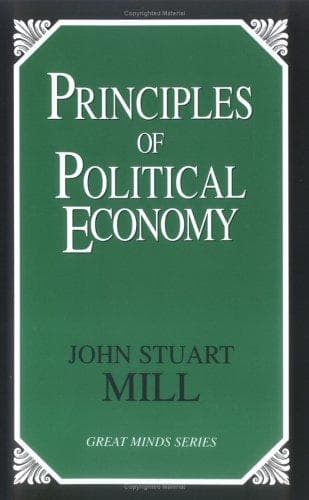
Principles of Political Economy: Abridged with Critical, Bibliographical, and Explanatory Notes, and a Sketch of the History of Political EconomyMill, John Stuart
PhilosophyPhilosophy
Principles of Political Economy: Abridged with Critical, Bibliographical, and Explanatory Notes, and a Sketch of the History of Political Economy
Mill, John Stuart
Economics
“Among those who call themselves Socialists, two kinds of persons may be
distinguished. There are, in the first place, (1) those whose plans for a
new order of society, in which private property and individual competition
are to be superseded and other motives to action substituted, are on the
scale of a village community or township, and would be applied to an
entire country by the multiplication of such self-acting units; of this
character are the systems of Owen, of Fourier, and the more thoughtful and
philosophic Socialists generally. The other class (2) who are more a
product of the Continent than of Great Britain, and may be called the
revolutionary Socialists, propose to themselves a much bolder stroke.
Their scheme is the management of the whole productive resources of the
country by one central authority, the general Government. And with this
view some of them avow as their purpose that the working-classes, or
somebody in their behalf, should take possession of all the property of
the country, and administer it for the general benefit. The aim of that is
to substitute the new rule for the old at a single stroke, and to exchange
the amount of good realized under the present system, and its large
possibilities of improvement, for a plunge without any preparation into
the most extreme form of the problem of carrying on the whole round of the
operations of social life without the motive power which has always
hitherto worked the social machinery. It must be acknowledged that those
who would play this game on the strength of their own private opinion,
unconfirmed as yet by any experimental verification, must have a serene
confidence in their own wisdom on the one hand, and a recklessness of
people’s sufferings on the other, which Robespierre and St. Just, hitherto
the typical instances of those united attributes, scarcely came up to.”
§ 4. Of various minor schemes, Communistic and Socialistic.
[Of the schemes to be tried within a state], the two elaborate forms of
non-communistic Socialism known as Saint-Simonism and Fourierism are
totally free from the objections usually urged against Communism. The
Saint-Simonian(155) scheme does not contemplate an equal, but an unequal
division of the produce; it does not propose that all should be occupied
alike, but differently, according to their vocation or capacity; the
function of each being assigned, like grades in a regiment, by the choice
of the directing authority, and the remuneration being by salary,
proportioned to the importance, in the eyes of that authority, of the
function itself, and the merits of the person who fulfills it. But to
suppose that one or a few human beings, howsoever selected, could, by
whatever machinery of subordinate agency, be qualified to adapt each
person’s work to his capacity, and proportion each person’s remuneration
to his merits, is a supposition almost too chimerical to be reasoned
against.(156)
Public-domain text, read in full here on John Shaqi.
Reviews
Reviews
No reviews yet
Be the first to share your thoughts on this work.
Elsewhere in the archive
Join the Discussion
Join the discussion
Sign in to leave a comment or review.
Sign InorCreate an account