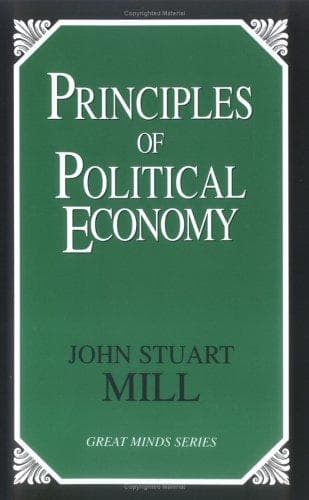
Principles of Political Economy: Abridged with Critical, Bibliographical, and Explanatory Notes, and a Sketch of the History of Political EconomyMill, John Stuart
PhilosophyPhilosophy
Principles of Political Economy: Abridged with Critical, Bibliographical, and Explanatory Notes, and a Sketch of the History of Political Economy
Mill, John Stuart
Economics
When the “sacredness of property” is talked of, it should always be
remembered that any such sacredness does not belong in the same degree to
landed property. No man made the land. It is the original inheritance of
the whole species. Its appropriation is wholly a question of general
expediency. When private property in land is not expedient, it is unjust.
The reverse is the case with property in movables, and in all things the
product of labor: over these, the owner’s power both of use and of
exclusion should be absolute, except where positive evil to others would
result from it; but, in the case of land, no exclusive right should be
permitted in any individual which can not be shown to be productive of
positive good. To be allowed any exclusive right at all, over a portion of
the common inheritance, while there are others who have no portion, is
already a privilege. No quantity of movable goods which a person can
acquire by his labor prevents others from acquiring the like by the same
means; but, from the very nature of the case, whoever owns land keeps
others out of the enjoyment of it. When land is not intended to be
cultivated, no good reason can in general be given for its being private
property at all. Even in the case of cultivated land, a man whom, though
only one among millions, the law permits to hold thousands of acres as his
single share, is not entitled to think that all this is given to him to
use and abuse, and deal with as if it concerned nobody but himself. The
rents or profits which he can obtain from it are at his sole disposal; but
with regard to the land, in everything which he does with it, and in
everything which he abstains from doing, he is morally bound, and should,
whenever the case admits, be legally compelled to make his interest and
pleasure consistent with the public good.
Chapter II. Of Wages.
§ 1. Of Competition and Custom.
Public-domain text, read in full here on John Shaqi.
Reviews
Reviews
No reviews yet
Be the first to share your thoughts on this work.
Elsewhere in the archive
Join the Discussion
Join the discussion
Sign in to leave a comment or review.
Sign InorCreate an account