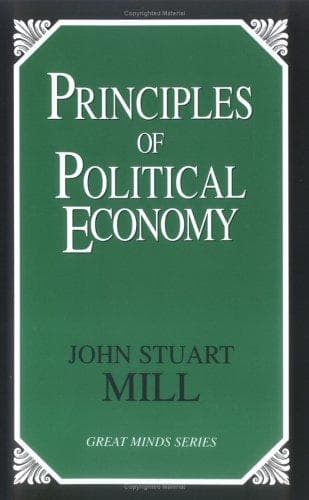
Principles of Political Economy: Abridged with Critical, Bibliographical, and Explanatory Notes, and a Sketch of the History of Political EconomyMill, John Stuart
PhilosophyPhilosophy
Principles of Political Economy: Abridged with Critical, Bibliographical, and Explanatory Notes, and a Sketch of the History of Political Economy
Mill, John Stuart
Economics
But it is altogether a false view of the state of facts to present this as
the relation which generally exists between agreeable and disagreeable
employments. The really exhausting and the really repulsive labors,
instead of being better paid than others, are almost invariably paid the
worst of all, because performed by those who have no choice. If the
laborers in the aggregate, instead of exceeding, fell short of the amount
of employment, work which was generally disliked would not be undertaken,
except for more than ordinary wages. But when the supply of labor so far
exceeds the demand that to find employment at all is an uncertainty, and
to be offered it on any terms a favor, the case is totally the reverse.
Partly from this cause, and partly from the natural and artificial
monopolies, which will be spoken of presently, the inequalities of wages
are generally in an opposite direction to the equitable principle of
compensation, erroneously represented by Adam Smith as the general law of
the remuneration of labor.
(3.) One of the points best illustrated by Adam Smith is the influence
exercised on the remuneration of an employment by the uncertainty of
success in it. If the chances are great of total failure, the reward in
case of success must be sufficient to make up, in the general estimation,
for those adverse chances. Put your son apprentice to a shoemaker, there
is little doubt of his learning to make a pair of shoes; but send him to
study the law, it is at least twenty to one if ever he makes such
proficiency as will enable him to live by the business. In a perfectly
fair lottery, those who draw the prizes ought to gain all that is lost by
those who draw the blanks. In a profession where twenty fail for one that
succeeds, that one ought to gain all that should have been gained by the
unsuccessful twenty. How extravagant soever the fees of counselors-at-law
may sometimes appear, their real retribution is never equal to this.
§ 2. Differences arising from Natural Monopolies.
The preceding are cases in which inequality of remuneration is necessary
to produce equality of attractiveness, and are examples of the equalizing
effect of free competition. The following are cases of real inequality,
and arise from a different principle.
Public-domain text, read in full here on John Shaqi.
Reviews
Reviews
No reviews yet
Be the first to share your thoughts on this work.
Elsewhere in the archive
Join the Discussion
Join the discussion
Sign in to leave a comment or review.
Sign InorCreate an account