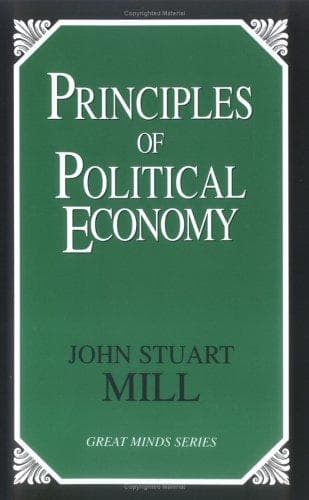
Principles of Political Economy: Abridged with Critical, Bibliographical, and Explanatory Notes, and a Sketch of the History of Political EconomyMill, John Stuart
PhilosophyPhilosophy
Principles of Political Economy: Abridged with Critical, Bibliographical, and Explanatory Notes, and a Sketch of the History of Political Economy
Mill, John Stuart
Economics
The hours per week have decreased in the same time from 84 to 66,
while the product of the mill in pounds has increased 25 per cent.
It may be unnecessary, perhaps, to say that these figures
represent the current wages in other mills at the same periods;
and that these facts can be sustained by the records of other
mills.
In its economic effect we must also consider, under efficiency,
the whole question of natural advantages of soil, climate, and
natural resources. Laborers of the same skill, paid the same real
wages, of the same cost, will produce a vastly greater amount of
wheat in Dakota than in Vermont or England. This is the chief
reason why profits are so high in the United States. In many
industries we have very marked natural advantages, which permits a
high reward to labor, and yet yields a high profit to the
capitalist. This applies not merely to agriculture, but to all the
extractive industries, such as the production of petroleum, wood,
copper, etc.
In short, the whole matter of ease and difficulty of production,
of high or low cost of production, taking it in the sense of great
or little sacrifice (compare carefully Book III, Chap. II, § 4),
comes in under the element of efficiency, in cost of labor. The
reader can not be too strongly urged to connect different parts of
the economic system together. And the questions of Cost of Labor
and Cost of Production are of paramount importance to a proper
understanding of political economy.
If labor generally became more efficient, without being more highly
rewarded; if, without its becoming less efficient, its remuneration fell,
no increase taking place in the cost of the articles composing that
remuneration; or if those articles became less costly, without the
laborers obtaining more of them; in any one of these three cases, profits
would rise. If, on the contrary, labor became less efficient (as it might
do from diminished bodily vigor in the people, destruction of fixed
capital, or deteriorated education); or if the laborer obtained a higher
remuneration, without any increased cheapness in the things composing it;
or if, without his obtaining more, that which he did obtain became more
costly; profits, in all these cases, would suffer a diminution. And there
is no other combination of circumstances in which the general rate of
profit of a country, in all employments indifferently, can either fall or
rise.
Public-domain text, read in full here on John Shaqi.
Reviews
Reviews
No reviews yet
Be the first to share your thoughts on this work.
Elsewhere in the archive
Join the Discussion
Join the discussion
Sign in to leave a comment or review.
Sign InorCreate an account