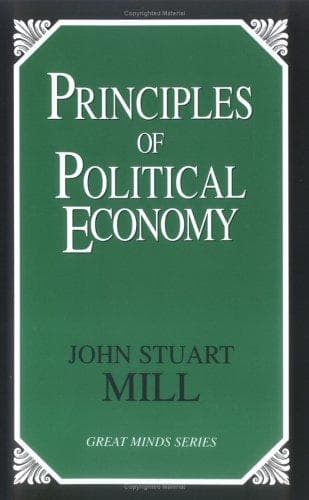
Principles of Political Economy: Abridged with Critical, Bibliographical, and Explanatory Notes, and a Sketch of the History of Political EconomyMill, John Stuart
PhilosophyPhilosophy
Principles of Political Economy: Abridged with Critical, Bibliographical, and Explanatory Notes, and a Sketch of the History of Political Economy
Mill, John Stuart
Economics
The requisites of production being labor, capital, and natural agents, the
only person, besides the laborer and the capitalist, whose consent is
necessary to production, and who can claim a share of the produce as the
price of that consent, is the person who, by the arrangements of society,
possesses exclusive power over some natural agent. The land is the
principal of the natural agents which are capable of being appropriated,
and the consideration paid for its use is called rent. Landed proprietors
are the only class, of any numbers or importance, who have a claim to a
share in the distribution of the produce, through their ownership of
something which neither they nor any one else have produced. If there be
any other cases of a similar nature, they will be easily understood, when
the nature and laws of rent are comprehended.
It is at once evident that rent is the effect of a monopoly. The reason
why land-owners are able to require rent for their land is, that it is a
commodity which many want, and which no one can obtain but from them. If
all the land of the country belonged to one person, he could fix the rent
at his pleasure. This case, however, is nowhere known to exist; and the
only remaining supposition is that of free competition; the land-owners
being supposed to be, as in fact they are, too numerous to combine.
The ratio of the land to the cultivators shows the limited
quantity of land. It is very desirable to keep the connection of
one part of the subject with another wherever possible.
“Agricultural rent, as it actually exists,” says Mr. Cairnes,(180)
truly, “is not a consequence of the _monopoly_ of the soil, but of
its diminishing productiveness.” The doctrine of rent depends upon
the law of diminishing returns; and it is only by the pressure of
population upon land that the lessened productiveness of land,
whether because of poorer qualities or poorer situations, is made
apparent. Or, to take things in their natural sequence, an
increase of population necessitates more food; and this implies a
resort to more expensive methods, or poorer soils, so soon as land
is pushed to the extent that it will not yield an increased crop
for the same application of labor and capital as formerly.
Different qualities of land, then, being in cultivation at the
same time, the better qualities must, of course, yield a greater
return than the poorer, and the conditions then exist under which
land pays rent. Those, therefore, who admit the law of diminishing
returns are inevitably led to the doctrine of rent.
§ 2. No Land can pay Rent except Land of such Quality or Situation as
exists in less Quantity than the Demand.
Public-domain text, read in full here on John Shaqi.
Reviews
Reviews
No reviews yet
Be the first to share your thoughts on this work.
Elsewhere in the archive
Join the Discussion
Join the discussion
Sign in to leave a comment or review.
Sign InorCreate an account