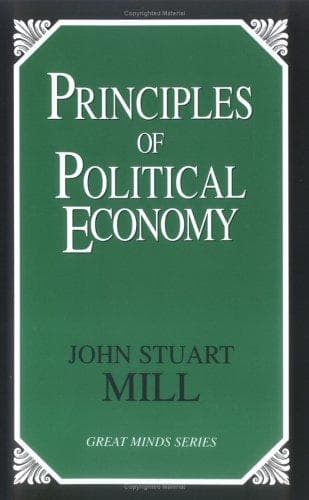
Principles of Political Economy: Abridged with Critical, Bibliographical, and Explanatory Notes, and a Sketch of the History of Political EconomyMill, John Stuart
PhilosophyPhilosophy
Principles of Political Economy: Abridged with Critical, Bibliographical, and Explanatory Notes, and a Sketch of the History of Political Economy
Mill, John Stuart
Economics
It will be true that the farmer requires the ordinary rate of profit on
the whole of his capital; that whatever it returns to him beyond this he
is obliged to pay to the landlord, but will not consent to pay more; that
there is a portion of capital applied to agriculture in such circumstances
of productiveness as to yield only the ordinary profits; and that the
difference between the produce of this and of any other capital of similar
amount is the measure of the tribute which that other capital can and will
pay, under the name of rent, to the landlord. This constitutes a law of
rent, as near the truth as such a law can possibly be; though of course
modified or disturbed, in individual cases, by pending contracts,
individual miscalculations, the influence of habit, and even the
particular feelings and dispositions of the persons concerned.
The law of rent, in the economic sense, operates in the United
States as truly as elsewhere, although there is no separate class
of landlords here. With us, almost all land is owned by the
cultivator; so that two functions, those of the landlord and
farmer, are both united in one person. Although one payment is
made, it is still just as distinctly made up of two parts, one of
which is a payment to the owner for the superior quality of his
soil, and the other a payment (to the same person, if the owner is
the cultivator) of profit on the farmer’s working capital. Land
which in the United States will only return enough to pay a profit
on this capital can not pay any rent. And land which can pay more
than a profit on this working capital, returns that excess as
rent, even if the farmer is also the owner and landlord. The
principle which regulates the amount of that excess—which is the
essential point—is the principle which determines the amount of
economic rent, and it holds true in the United States or Finland,
provided only that different grades of land are called into
cultivation. The governing principle is the same, no matter
whether a payment is made to one man as profit and to another as
rent, or whether the two payments are made to the same man in two
capacities. It has been urged that the law of rent does not hold
in the United States, because “the price of grain and other
agricultural produce has not risen in proportion to the increase
of our numbers, as it ought to have done if Ricardo’s theory were
true, but has fallen, since 1830, though since that time our
population has been more than tripled.”(181) This overlooks the
fact that we have not even yet taken up all our best agricultural
lands, so that for some products the law of diminishing
productiveness has not yet shown itself. The reason is, that the
extension of our railway system has only of late years brought the
really good grain-lands into cultivation. The fact that there has
Public-domain text, read in full here on John Shaqi.
Reviews
Reviews
No reviews yet
Be the first to share your thoughts on this work.
Elsewhere in the archive
Join the Discussion
Join the discussion
Sign in to leave a comment or review.
Sign InorCreate an account