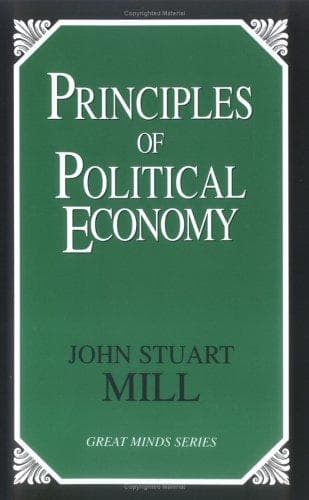
Principles of Political Economy: Abridged with Critical, Bibliographical, and Explanatory Notes, and a Sketch of the History of Political EconomyMill, John Stuart
PhilosophyPhilosophy
Principles of Political Economy: Abridged with Critical, Bibliographical, and Explanatory Notes, and a Sketch of the History of Political Economy
Mill, John Stuart
Economics
In whatever order the lands come into cultivation, those which when
cultivated yield the least return, in proportion to the labor required for
their culture, will always regulate the price of agricultural produce; and
all other lands will pay a rent simply equivalent to the excess of their
produce over this minimum. Whatever unguarded expressions may have been
occasionally used in describing the law of rent, these two propositions
are all that was ever intended by it. If, indeed, Mr. Carey could show
that the return to labor from the land, agricultural skill and science
being supposed the same, is not a diminishing return, he would overthrow a
principle much more fundamental than any law of rent. But in this he has
wholly failed.
Another objection taken against the law of diminishing returns,
and so against the law of rent, is that the potential increase of
food, e.g., of a grain of wheat, is far greater than that of
man.(183) No one disputes the fact that one grain of wheat can
reproduce itself more times than man, and that too in a geometric
increase; but not without land. A grain of wheat needs land in
which it can multiply itself, and this necessary element of its
increase is limited; and it is the very thing which limits the
multiplication of the grains of wheat. On the same piece of land,
one can not get more than what comes from one act of reproduction
in the grain. If one grain produces 100 of its kind, doubling the
capital will not repeatedly cause a geometric increase in the
ratio of reproduction of each grain on this same land, so that one
grain, by one process, produces of its kind 200, 400, 800, or
1,600, because you can not multiply the land in any such ratio as
would accompany this potential reduplication of the grain. This
objection would not seem worth answering, were it not that it
furnishes some difficulty to really honest inquirers.
Others, again, allege as an objection against Ricardo, that if all land
were of equal fertility it might still yield a rent. But Ricardo says
precisely the same. It is also distinctly a portion of Ricardo’s doctrine
that, even apart from differences of situation, the land of a country
supposed to be of uniform fertility would, all of it, on a certain
supposition, pay rent, namely, if the demand of the community required
that it should all be cultivated, and cultivated beyond the point at which
a further application of capital begins to be attended with a smaller
proportional return.
Public-domain text, read in full here on John Shaqi.
Reviews
Reviews
No reviews yet
Be the first to share your thoughts on this work.
Elsewhere in the archive
Join the Discussion
Join the discussion
Sign in to leave a comment or review.
Sign InorCreate an account