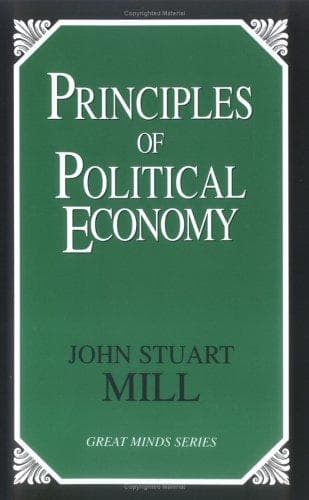
Principles of Political Economy: Abridged with Critical, Bibliographical, and Explanatory Notes, and a Sketch of the History of Political EconomyMill, John Stuart
PhilosophyPhilosophy
Principles of Political Economy: Abridged with Critical, Bibliographical, and Explanatory Notes, and a Sketch of the History of Political Economy
Mill, John Stuart
Economics
It is evident that, of the two great departments of Political Economy, the
production of wealth and its distribution, the consideration of Value has
to do with the latter alone; and with that only so far as competition, and
not usage or custom, is the distributing agency.
The use of a thing, in political economy, means its capacity to satisfy a
desire, or serve a purpose. Diamonds have this capacity in a high degree,
and, unless they had it, would not bear any price. Value in use, or, as
Mr. De Quincey calls it, _teleologic_ value, is the extreme limit of value
in exchange. The exchange value of a thing may fall short, to any amount,
of its value in use; but that it can ever exceed the value in use implies
a contradiction; it supposes that persons will give, to possess a thing,
more than the utmost value which they themselves put upon it, as a means
of gratifying their inclinations.
The word Value, when used without adjunct, always means, in political
economy, value in exchange.
Exchange value requires to be distinguished from Price. Writers have
employed Price to express the value of a thing in relation to money—the
quantity of money for which it will exchange. By the price of a thing,
therefore, we shall henceforth understand its value in money; by the
value, or exchange value of a thing, its general power of purchasing; the
command which its possession gives over purchasable commodities in
general. What is meant by command over commodities in general? The same
thing exchanges for a greater quantity of some commodities, and for a very
small quantity of others. A coat may exchange for less bread this year
than last, if the harvest has been bad, but for more glass or iron, if a
tax has been taken off those commodities, or an improvement made in their
manufacture. Has the value of the coat, under these circumstances, fallen
or risen? It is impossible to say: all that can be said is, that it has
fallen in relation to one thing, and risen in respect to another. Suppose,
for example, that an invention has been made in machinery, by which
broadcloth could be woven at half the former cost. The effect of this
would be to lower the value of a coat, and, if lowered by this cause, it
would be lowered not in relation to bread only or to glass only, but to
all purchasable things, except such as happened to be affected at the very
time by a similar depressing cause. Those [changes] which originate in the
commodities with which we compare it affect its value in relation to those
commodities; but those which originate in itself affect its value in
relation to all commodities.
Public-domain text, read in full here on John Shaqi.
Reviews
Reviews
No reviews yet
Be the first to share your thoughts on this work.
Elsewhere in the archive
Join the Discussion
Join the discussion
Sign in to leave a comment or review.
Sign InorCreate an account