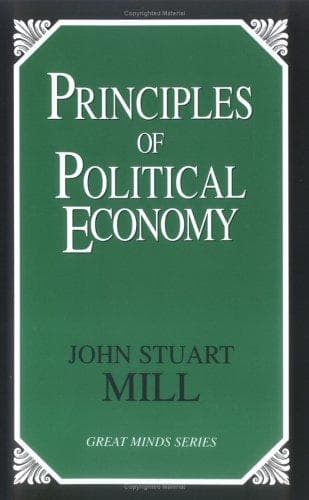
Principles of Political Economy: Abridged with Critical, Bibliographical, and Explanatory Notes, and a Sketch of the History of Political EconomyMill, John Stuart
PhilosophyPhilosophy
Principles of Political Economy: Abridged with Critical, Bibliographical, and Explanatory Notes, and a Sketch of the History of Political Economy
Mill, John Stuart
Economics
Now the relation of one thing to another can not be altered by any cause
which affects them both alike. A rise or fall of general wages is a fact
which affects all commodities in the same manner, and therefore affords no
reason why they should exchange for each other in one rather than in
another proportion. Though there is no such thing as a general rise of
values, there is such a thing as a general rise of prices. As soon as we
form distinctly the idea of values, we see that high or low wages can have
nothing to do with them; but that high wages make high prices, is a
popular and widely spread opinion. The whole amount of error involved in
this proposition can only be seen thoroughly when we come to the theory of
money; at present we need only say that if it be true, there can be no
such thing as a real rise of wages; for if wages could not rise without a
proportional rise of the price of everything, they could not, for any
substantial purpose, rise at all. It must be remembered, too, that general
high prices, even supposing them to exist, can be of no use to a producer
or dealer, considered as such; for, if they increase his money returns,
they increase in the same degree all his expenses. There is no mode in
which capitalists can compensate themselves for a high cost of labor,
through any action on values or prices. It can not be prevented from
taking its effect in low profits. If the laborers really get more, that
is, get the produce of more labor, a smaller percentage must remain for
profit.
§ 2. Wages affect Values, only if different in different employments;
“non-competing groups.”
Although, however, _general_ wages, whether high or low, do not affect
values, yet if wages are higher in one employment than another, or if they
rise or fall permanently in one employment without doing so in others,
these inequalities do really operate upon values. Things, for example,
which are made by skilled labor, exchange for the produce of a much
greater quantity of unskilled labor, for no reason but because the labor
is more highly paid. We have before remarked that the difficulty of
passing from one class of employments to a class greatly superior has
hitherto caused the wages of all those classes of laborers who are
separated from one another by any very marked barrier to depend more than
might be supposed upon the increase of the population of each class
considered separately, and that the inequalities in the remuneration of
labor are much greater than could exist if the competition of the laboring
people generally could be brought practically to bear on each particular
employment. It follows from this that wages in different employments do
not rise or fall simultaneously, but are, for short and sometimes even for
long periods, nearly independent of one another. All such disparities
evidently alter the _relative_ cost of production of different
commodities, and will therefore be completely represented in their natural
or average value.
Public-domain text, read in full here on John Shaqi.
Reviews
Reviews
No reviews yet
Be the first to share your thoughts on this work.
Elsewhere in the archive
Join the Discussion
Join the discussion
Sign in to leave a comment or review.
Sign InorCreate an account