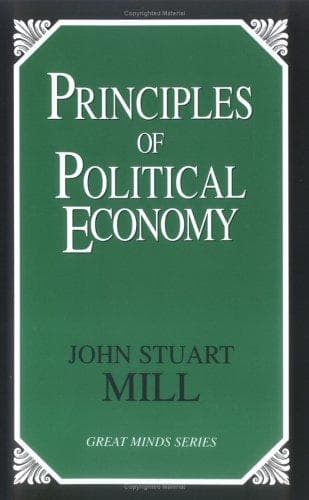
Principles of Political Economy: Abridged with Critical, Bibliographical, and Explanatory Notes, and a Sketch of the History of Political EconomyMill, John Stuart
PhilosophyPhilosophy
Principles of Political Economy: Abridged with Critical, Bibliographical, and Explanatory Notes, and a Sketch of the History of Political Economy
Mill, John Stuart
Economics
All commodities made by machinery are assimilated, at least approximately,
to the wine in the preceding example. In comparison with things made
wholly by immediate labor, profits enter more largely into their cost of
production. Suppose two commodities, A and B, each requiring a year for
its production, by means of a capital which we will on this occasion
denote by money, and suppose it to be £1,000. A is made wholly by
immediate labor, the whole £1,000 being expended directly in wages. B is
made by means of labor which cost £500 and a machine which cost £500, and
the machine is worn out by one year’s use. The two commodities will be of
exactly the same value, which, if computed in money, and if profits are 20
per cent per annum, will be £1,200. But of this £1,200, in the case of A,
only £200, or one sixth, is profit; while in the case of B there is not
only the £200, but as much of £500 (the price of the machine) as consisted
of the profits of the machine-maker; which, if we suppose the machine also
to have taken a year for its production, is again one sixth. So that in
the case of A only one sixth of the entire return is profit, while in B
the element of profit comprises not only a sixth of the whole, but an
additional sixth of a large part.
From the unequal proportion in which, in different employments, profits
enter into the advances of the capitalist, and therefore into the returns
required by him, two consequences follow in regard to value. (1). One is,
that commodities do not exchange in the ratio simply of the quantities of
labor required to produce them; not even if we allow for the unequal rates
at which different kinds of labor are permanently remunerated.
(2.) A second consequence is, that every rise or fall of general profits
will have an effect on values. Not, indeed, by raising or lowering them
generally (which, as we have so often said, is a contradiction and an
impossibility), but by altering the proportion in which the values of
things are affected by the unequal lengths of time for which profit is
due. When two things, though made by equal labor, are of unequal value
because the one is called upon to yield profit for a greater number of
years or months than the other, this difference of value will be greater
when profits are greater, and less when they are less. The wine which has
to yield five years’ profit more than the cloth will surpass it in value
much more if profits are forty per cent than if they are only twenty.
Public-domain text, read in full here on John Shaqi.
Reviews
Reviews
No reviews yet
Be the first to share your thoughts on this work.
Elsewhere in the archive
Join the Discussion
Join the discussion
Sign in to leave a comment or review.
Sign InorCreate an account