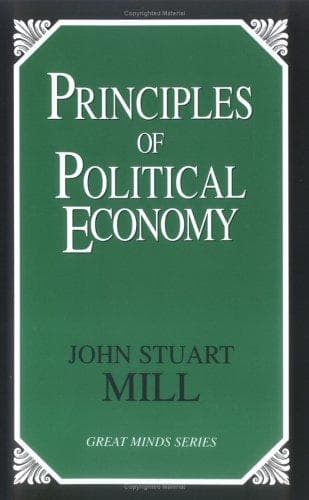
Principles of Political Economy: Abridged with Critical, Bibliographical, and Explanatory Notes, and a Sketch of the History of Political EconomyMill, John Stuart
PhilosophyPhilosophy
Principles of Political Economy: Abridged with Critical, Bibliographical, and Explanatory Notes, and a Sketch of the History of Political Economy
Mill, John Stuart
Economics
We have investigated the laws which determine the value of two classes of
commodities—the small class which, being limited to a definite quantity,
have their value entirely determined by demand and supply, save that their
cost of production (if they have any) constitutes a minimum below which
they can not permanently fall; and the large class, which can be
multiplied _ad libitum_ by labor and capital, and of which the cost of
production fixes the maximum as well as the minimum at which they can
permanently exchange [if there be free competition]. But there is still a
third kind of commodities to be considered—those which have, not one, but
several costs of production; which can always be increased in quantity by
labor and capital, but not by the same amount of labor and capital; of
which so much may be produced at a given cost, but a further quantity not
without a greater cost. These commodities form an intermediate class,
partaking of the character of both the others. The principal of them is
agricultural produce. We have already made abundant reference to the
fundamental truth that in agriculture, the state of the art being given,
doubling the labor does not double the produce; that, if an increased
quantity of produce is required, the additional supply is obtained at a
greater cost than the first. Where a hundred quarters of corn are all that
is at present required from the lands of a given village, if the growth of
population made it necessary to raise a hundred more, either by breaking
up worse land now uncultivated, or by a more elaborate cultivation of the
land already under the plow, the additional hundred, or some part of them,
at least, might cost double or treble as much per quarter as the former
supply.
Public-domain text, read in full here on John Shaqi.
Reviews
Reviews
No reviews yet
Be the first to share your thoughts on this work.
Elsewhere in the archive
Join the Discussion
Join the discussion
Sign in to leave a comment or review.
Sign InorCreate an account