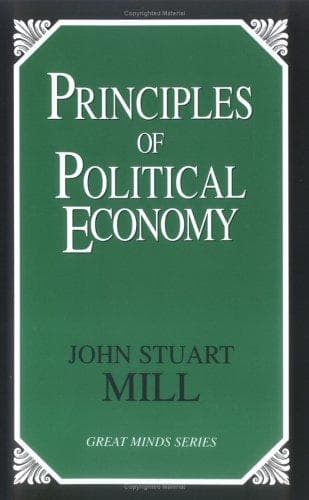
Principles of Political Economy: Abridged with Critical, Bibliographical, and Explanatory Notes, and a Sketch of the History of Political EconomyMill, John Stuart
PhilosophyPhilosophy
Principles of Political Economy: Abridged with Critical, Bibliographical, and Explanatory Notes, and a Sketch of the History of Political Economy
Mill, John Stuart
Economics
Agricultural productions are not the only commodities which have several
different costs of production at once, and which, in consequence of that
difference, and in proportion to it, afford a rent. Mines are also an
instance. Almost all kinds of raw material extracted from the interior of
the earth—metals, coals, precious stones, etc.—are obtained from mines
differing considerably in fertility—that is, yielding very different
quantities of the product to the same quantity of labor and capital. There
are, perhaps, cases in which it is impossible to extract from a particular
vein, in a given time, more than a certain quantity of ore, because there
is only a limited surface of the vein exposed, on which more than a
certain number of laborers can not be simultaneously employed. But this is
not true of all mines. In collieries, for example, some other cause of
limitation must be sought for. In some instances the owners limit the
quantity raised, in order not too rapidly to exhaust the mine; in others
there are said to be combinations of owners, to keep up a monopoly price
by limiting the production. Whatever be the causes, it is a fact that
mines of different degrees of richness are in operation, and since the
value of the produce must be proportional to the cost of production at the
worst mine (fertility and situation taken together), it is more than
proportional to that of the best. All mines superior in produce to the
worst actually worked will yield, therefore, a rent equal to the excess.
They may yield more; and the worst mine may itself yield a rent. Mines
being comparatively few, their qualities do not graduate gently into one
another, as the qualities of land do; and the demand may be such as to
keep the value of the produce considerably above the cost of production at
the worst mine now worked, without being sufficient to bring into
operation a still worse. During the interval, the produce is really at a
scarcity value.
Fisheries are another example. Fisheries in the open sea are not
appropriated, but fisheries in lakes or rivers almost always are so, and
likewise oyster-beds or other particular fishing-grounds on coasts. We may
take salmon-fisheries as an example of the whole class. Some rivers are
far more productive in salmon than others. None, however, without being
exhausted, can supply more than a very limited demand. All others,
therefore, will, if appropriated, afford a rent equal to the value of
their superiority.
Public-domain text, read in full here on John Shaqi.
Reviews
Reviews
No reviews yet
Be the first to share your thoughts on this work.
Elsewhere in the archive
Join the Discussion
Join the discussion
Sign in to leave a comment or review.
Sign InorCreate an account