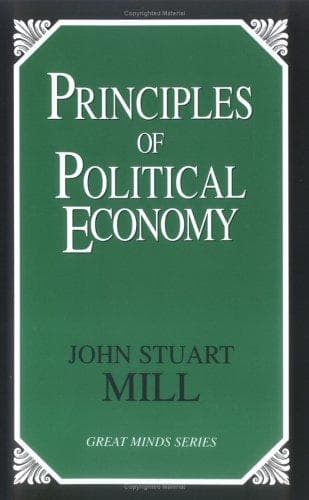
Principles of Political Economy: Abridged with Critical, Bibliographical, and Explanatory Notes, and a Sketch of the History of Political EconomyMill, John Stuart
PhilosophyPhilosophy
Principles of Political Economy: Abridged with Critical, Bibliographical, and Explanatory Notes, and a Sketch of the History of Political Economy
Mill, John Stuart
Economics
A Measure of Value,(224) in the ordinary sense of the word measure, would
mean something by comparison with which we may ascertain what is the value
of any other thing. When we consider, further, that value itself is
relative, and that two things are necessary to constitute it,
independently of the third thing which is to measure it, we may define a
Measure of Value to be something, by comparing with which any two other
things, we may infer their value in relation to one another.
In this sense, any commodity will serve as a measure of value at a given
time and place; since we can always infer the proportion in which things
exchange for one another, when we know the proportion in which each
exchanges for any third thing. To serve as a convenient measure of value
is one of the functions of the commodity selected as a medium of exchange.
It is in that commodity that the values of all other things are habitually
estimated.
But the desideratum sought by political economists is not a measure of the
value of things at the same time and place, but a measure of the value of
the same thing at different times and places: something by comparison with
which it may be known whether any given thing is of greater or less value
now than a century ago, or in this country than in America or China. To
enable the money price of a thing at two different periods to measure the
quantity of things in general which it will exchange for, the same sum of
money must correspond at both periods to the same quantity of things in
general—that is, money must always have the same exchange value, the same
general purchasing power. Now, not only is this not true of money, or of
any other commodity, but we can not even suppose any state of
circumstances in which it would be true.
It being very clear that money, or the precious metals, do not
themselves remain absolutely stable in value for long periods, the
only way in which a “standard of value” can be properly
established is by the proposed “multiple standard of value,”
stated as follows:
Public-domain text, read in full here on John Shaqi.
Reviews
Reviews
No reviews yet
Be the first to share your thoughts on this work.
Elsewhere in the archive
Join the Discussion
Join the discussion
Sign in to leave a comment or review.
Sign InorCreate an account