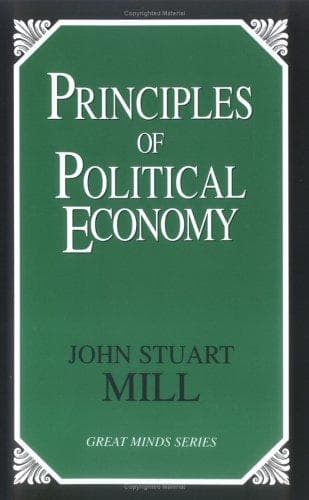
Principles of Political Economy: Abridged with Critical, Bibliographical, and Explanatory Notes, and a Sketch of the History of Political EconomyMill, John Stuart
PhilosophyPhilosophy
Principles of Political Economy: Abridged with Critical, Bibliographical, and Explanatory Notes, and a Sketch of the History of Political Economy
Mill, John Stuart
Economics
There is an obvious convenience in making use of the more costly metal for
larger payments, and the cheaper one for smaller; and the only question
relates to the mode in which this can best be done. The mode most
frequently adopted has been to establish between the two metals a fixed
proportion [to decide by law, for example, that sixteen grains of silver
should be equivalent to one grain of gold]; and it being left free to
every one who has a [dollar] to pay, either to pay it in the one metal or
in the other.
If [their] natural or cost values always continued to bear the same ratio
to one another, the arrangement would be unobjectionable. This, however,
is far from being the fact. Gold and silver, though the least variable in
value of all commodities, are not invariable, and do not always vary
simultaneously. Silver, for example, was lowered in permanent value more
than gold by the discovery of the American mines; and those small
variations of value which take place occasionally do not affect both
metals alike. Suppose such a variation to take place—the value of the two
metals relatively to one another no longer agreeing with their rated
proportion—one or other of them will now be rated below its bullion value,
and there will be a profit to be made by melting it.
Suppose, for example, that gold rises in value relatively to silver, so
that the quantity of gold in a sovereign is now worth more than the
quantity of silver in twenty shillings. Two consequences will ensue. No
debtor will any longer find it his interest to pay in gold. He will always
pay in silver, because twenty shillings are a legal tender for a debt of
one pound, and he can procure silver convertible into twenty shillings for
less gold than that contained in a sovereign. The other consequence will
be that, unless a sovereign can be sold for more than twenty shillings,
all the sovereigns will be melted, since as bullion they will purchase a
greater number of shillings than they exchange for as coin. The converse
of all this would happen if silver, instead of gold, were the metal which
had risen in comparative value. A sovereign would not now be worth so much
as twenty shillings, and whoever had a pound to pay would prefer paying it
by a sovereign; while the silver coins would be collected for the purpose
of being melted, and sold as bullion for gold at their real value—that is,
above the legal valuation. The money of the community, therefore, would
never really consist of both metals, but of the one only which, at the
particular time, best suited the interest of debtors; and the standard of
the currency would be constantly liable to change from the one metal to
the other, at a loss, on each change, of the expense of coinage on the
metal which fell out of use.
Public-domain text, read in full here on John Shaqi.
Reviews
Reviews
No reviews yet
Be the first to share your thoughts on this work.
Elsewhere in the archive