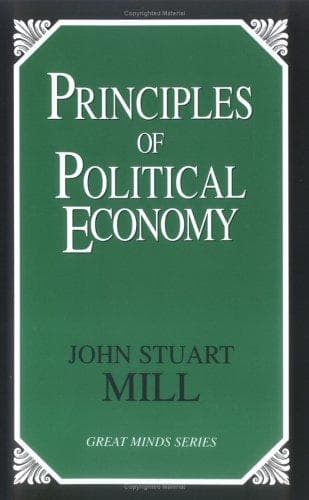
Principles of Political Economy: Abridged with Critical, Bibliographical, and Explanatory Notes, and a Sketch of the History of Political EconomyMill, John Stuart
PhilosophyPhilosophy
Principles of Political Economy: Abridged with Critical, Bibliographical, and Explanatory Notes, and a Sketch of the History of Political Economy
Mill, John Stuart
Economics
The experience of the United States with a double standard,
extending as it does from 1792 to 1873 without a break, and from
1878 to the present time, is a most valuable source of instruction
in regard to the practical working of bimetallism. While we have
nominally had a double standard, in reality we have either had one
alone, or been in a transition from one to the other standard; and
the history of our coinage strikingly illustrates the truth that
the natural values of the two metals, in spite of all legislation,
so vary relatively to each other that a constant ratio can not be
maintained for any length of time; and that “the poor money drives
out the good,” according to Gresham’s statement. For clearness,
the period may be divided, in accordance with the changes of
legislation, into four divisions:
I. 1792-1834. Transition from gold to silver.
II. 1834-1853. Transition from silver to gold.
III. 1853-1878. Single gold currency (except 1862-1879, the paper
period).
IV. 1878-1884. Transition from gold to silver.
I. With the establishment of the mint, Hamilton agreed upon the
use of both gold and silver in our money, at a ratio of 15 to 1:
that is, that the amount of pure silver in a dollar should be
fifteen times the weight of gold in a dollar. So, while the
various Spanish dollars then in circulation in the United States
seemed to contain on the average about 371-¼ grains of pure
silver, and since Hamilton believed the relative market value of
gold and silver to be about 1 to 15, he put 1/15 of 371-¼ grains,
or 24-¾ grains of pure gold, into the gold dollar. It was the best
possible example of the bimetallic system to be found, and the
mint ratio was intended to conform to the market ratio. If this
conformity could have been maintained, there would have been no
disturbance. But a cause was already in operation affecting the
supply of one of the metals—silver—wholly independent of
legislation, and without correspondingly affecting gold.
Public-domain text, read in full here on John Shaqi.
Reviews
Reviews
No reviews yet
Be the first to share your thoughts on this work.
Elsewhere in the archive
Join the Discussion
Join the discussion
Sign in to leave a comment or review.
Sign InorCreate an account