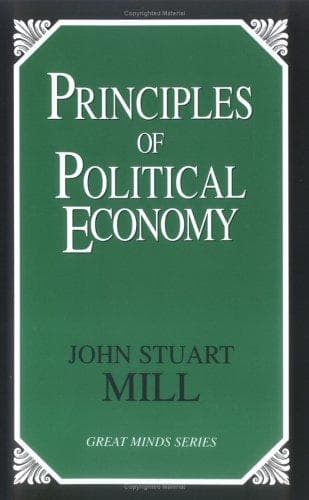
Principles of Political Economy: Abridged with Critical, Bibliographical, and Explanatory Notes, and a Sketch of the History of Political EconomyMill, John Stuart
PhilosophyPhilosophy
Principles of Political Economy: Abridged with Critical, Bibliographical, and Explanatory Notes, and a Sketch of the History of Political Economy
Mill, John Stuart
Economics
The credit given to any one by those with whom he deals does not depend on
the quantity of bank-notes or coin in circulation at the time, but on
their opinion of his solvency. If any consideration of a more general
character enters into their calculation, it is only in a time of pressure
on the loan market, when they are not certain of being themselves able to
obtain the credit on which they have been accustomed to rely; and even
then, what they look to is the general state of the loan market, and not
(preconceived theory apart) the amount of bank-notes. So far, as to the
willingness to _give_ credit. And the willingness of a dealer to _use_ his
credit depends on his expectations of gain, that is, on his opinion of the
probable future price of his commodity; an opinion grounded either on the
rise or fall already going on, or on his prospective judgment respecting
the supply and the rate of consumption. When a dealer extends his
purchases beyond his immediate means of payment, engaging to pay at a
specified time, he does so in the expectation either that the transaction
will have terminated favorably before that time arrives, or that he shall
then be in possession of sufficient funds from the proceeds of his other
transactions. The fulfillment of these expectations depends upon prices,
but not specially upon the amount of bank-notes. It is obvious, however,
that prices do not depend on money, but on purchases. Money left with a
banker, and not drawn against, or drawn against for other purposes than
buying commodities, has no effect on prices, any more than credit which is
not used. Credit which _is_ used to purchase commodities affects prices in
the same manner as money. Money and credit are thus exactly on a par in
their effect on prices.
Public-domain text, read in full here on John Shaqi.
Reviews
Reviews
No reviews yet
Be the first to share your thoughts on this work.
Elsewhere in the archive
Join the Discussion
Join the discussion
Sign in to leave a comment or review.
Sign InorCreate an account