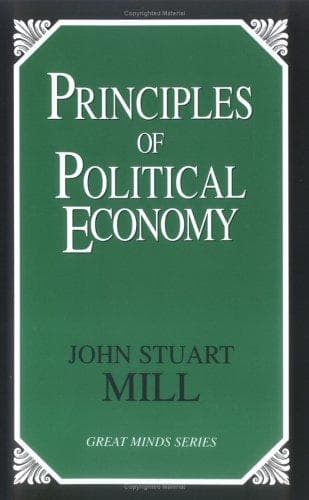
Principles of Political Economy: Abridged with Critical, Bibliographical, and Explanatory Notes, and a Sketch of the History of Political EconomyMill, John Stuart
PhilosophyPhilosophy
Principles of Political Economy: Abridged with Critical, Bibliographical, and Explanatory Notes, and a Sketch of the History of Political Economy
Mill, John Stuart
Economics
We have seen, however, that even in the case of metallic currency, the
immediate agency in determining its value is its quantity. If the
quantity, instead of depending on the ordinary mercantile motives of
profit and loss, could be arbitrarily fixed by authority, the value would
depend on the fiat of that authority, not on cost of production. The
quantity of a paper currency not convertible into the metals at the option
of the holder _can_ be arbitrarily fixed, especially if the issuer is the
sovereign power of the state. The value, therefore, of such a currency is
entirely arbitrary.
The value of paper money is, of course, primarily and mainly
dependent on the quantity issued. The general level of value
depends on the _quantity_; but we also find that deviations from
this general level, in the direction of further depreciation than
could be due to quantity alone, is caused by any event which
shakes the confidence of any one that he may get the existing
value for his paper. The “convention” by which real value (the
essential idea of money) was associated with this paper in the
minds of all is thereby broken. _Fiat_ money—that is, a piece of
paper, not containing a promise to pay a dollar, but a simple
declaration that this is a dollar—therefore, separates the paper
from any connection with value. And yet we see that _fiat_ money
has some, although a fluctuating, value at certain times: if the
State receives it for taxes, if it is a legal acquittal of
obligations, then, to that extent, a certain quantity of it is
given a value equal to the wealth represented by the taxes, or the
debts. Jevons remarks on this point(247) that, if “the quantity of
notes issued was kept within such moderate limits that any one
wishing to realize the metallic value of the notes could find some
one wanting to pay taxes, and therefore willing to give coin for
notes,” stability of value might be secured. If there is more in
circulation than performs these functions, it will depreciate in
the proportion of the _quantity_ to the extent of the uses
assigned to it; so that the relation of quantity to uses is the
only thing which can give value to _fiat_ money, but beyond a
certain point in the issues other forces than mere quantity begin
to affect the value. Although the paper is not even a promise to
pay value, the form of expression on its face, or the term used as
its designation, generally tends, under the force of convention
and habit, to give a popular value to paper.
Public-domain text, read in full here on John Shaqi.
Reviews
Reviews
No reviews yet
Be the first to share your thoughts on this work.
Elsewhere in the archive
Join the Discussion
Join the discussion
Sign in to leave a comment or review.
Sign InorCreate an account