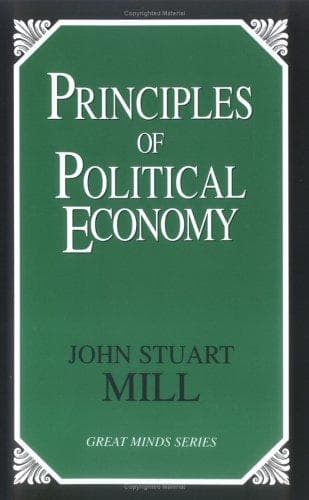
Principles of Political Economy: Abridged with Critical, Bibliographical, and Explanatory Notes, and a Sketch of the History of Political EconomyMill, John Stuart
PhilosophyPhilosophy
Principles of Political Economy: Abridged with Critical, Bibliographical, and Explanatory Notes, and a Sketch of the History of Political Economy
Mill, John Stuart
Economics
One other form of this question needs brief mention. It is truly
remarked that a large portion of industrial activity is engaged
to-day, not in supplying productive consumption, such as food,
shelter, and clothing, but in supplying the comforts and luxuries
of low and high alike, or unproductive consumption; now, if there
were not a demand for luxuries and comforts, many vast industries
would cease to exist, and labor would be thrown out of employment.
Is not a demand for such commodities, then, a cause of the present
employment of labor? No, it is not. Luxuries and comforts are of
course the objects of human wants; but a desire alone, without
purchasing power, can not either buy or produce these commodities.
To obtain a piano, one must produce goods, and this implies the
possession of capital, by which to bring into existence goods, or
purchasing power, to be offered for a piano. Nor is this
sufficient. Even after a man, A, for example, offers purchasing
power, he will not get a piano unless there exists an accumulation
of unemployed capital, together with labor ready to manufacture
the instrument. If capital were all previously occupied, no piano
could be made, although A stood offering an equivalent in valuable
goods. It may be said that A himself has the means. He has the
_wealth_, and if he is willing to forego the use of this wealth,
or, in other words, save it by devoting it to reproduction in the
piano industry—that is, create the capital necessary for the
purpose—then the piano can be made. But this shows again that, not
a mere desire, but the existence of capital, is necessary to the
production, and so to the employment of labor. An increased demand
for commodities, therefore, does not give additional employment to
labor, unless there be capital to support the labor.
Some important corollaries result from this proposition: (_a._)
When a country by legislation creates a home demand for
commodities, that does not of itself give additional employment to
labor. If the goods had before been purchased abroad, under free
discretion, then if produced at home they must require more
capital and labor, or they would not have been brought from
foreign countries. If produced at home, it would require, to
purchase them, more of what was formerly sent abroad; or some must
do without. The legislation can not, _ipso facto_, create capital,
and only by an increase of capital can more employment result. It
is possible, however, that legislation might cause a more
effective use of existing capital; but that must be a question of
fact, to be settled by circumstances in each particular case. It
is not a thing to be governed by principles.
Public-domain text, read in full here on John Shaqi.
Reviews
Reviews
No reviews yet
Be the first to share your thoughts on this work.
Elsewhere in the archive
Join the Discussion
Join the discussion
Sign in to leave a comment or review.
Sign InorCreate an account