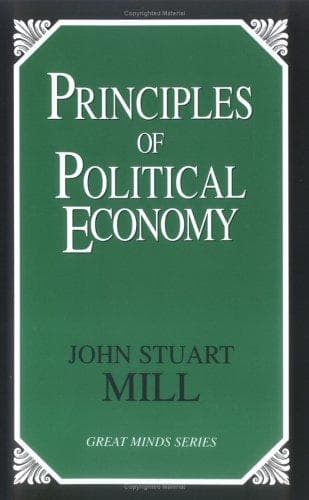
Principles of Political Economy: Abridged with Critical, Bibliographical, and Explanatory Notes, and a Sketch of the History of Political EconomyMill, John Stuart
PhilosophyPhilosophy
Principles of Political Economy: Abridged with Critical, Bibliographical, and Explanatory Notes, and a Sketch of the History of Political Economy
Mill, John Stuart
Economics
The increase of labor is the increase of mankind; of population. The power
of multiplication inherent in all organic life may be regarded as
infinite. There are many species of vegetables of which a single plant
will produce in one year the germs of a thousand; if only two come to
maturity, in fourteen years the two will have multiplied to sixteen
thousand and more. It is but a moderate case of fecundity in animals to be
capable of quadrupling their numbers in a single year; if they only do as
much in half a century, ten thousand will have swelled within two
centuries to upward to two millions and a half. The capacity of increase
is necessarily in a geometrical progression: the numerical ratio alone is
different.
To this property of organized beings, the human species forms no
exception. Its power of increase is indefinite, and the actual
multiplication would be extraordinarily rapid, if the power were exercised
to the utmost. It never is exercised to the utmost, and yet, in the most
favorable circumstances known to exist, which are those of a fertile
region colonized from an industrious and civilized community, population
has continued, for several generations, independently of fresh
immigration, to double itself in not much more than twenty years.
Years. Population. Food.
25 11 mills x
25 22 mills 2x
25 44 mills 3x
25 88 mills 4x
25 176 mills 5x
By this table it will be seen that if population can double itself
in twenty-five years, and if food can only be increased by as much
as _x_ (the subsistence of eleven millions) by additional
application of another equal quantity of labor on the same land in
each period, then at the end of one hundred years there would be
the disproportion of one hundred and seventy-six millions of
people, with subsistence for only fifty-five millions. Of course,
this is prevented either by checking population to the amount of
the subsistence; by sending off the surplus population; or by
bringing in food from new lands.
Public-domain text, read in full here on John Shaqi.
Reviews
Reviews
No reviews yet
Be the first to share your thoughts on this work.
Elsewhere in the archive
Join the Discussion
Join the discussion
Sign in to leave a comment or review.
Sign InorCreate an account