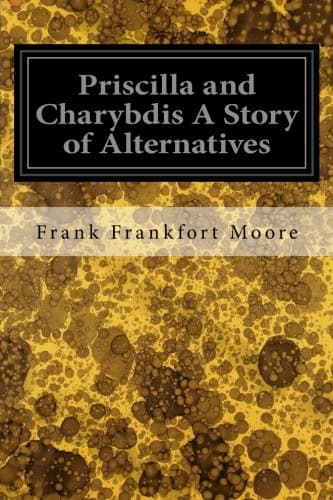
Priscilla and Charybdis: A Story of AlternativesMoore, Frank Frankfort
General
Priscilla and Charybdis: A Story of Alternatives
Moore, Frank Frankfort
Fiction
Then there was Farmer Wadhurst; he was a straightforward man and a
man of business, and though officially connected with the church, yet
without that adroitness at misleading through the medium of verbally
accurate phrases, which--according to Framsby’s best set--is
characteristic of parsons and the members of their families--Mr.
Wadhurst might be approached on the subject of his daughters engagement.
But Mr. Wadhurst was not easy of approach on social matters, though
always ready to talk of “cake.” He had his theories regarding this form
of confectionery for milch kine, and was always ready to say which breed
should take the cake, and in what quantities. But he quickly repelled
the approach of such persons as came to congratulate him on the
engagement of his daughter--a fact that caused them to wink at their
friends and say that that was the right position for a yeoman to take up
in respect of his daughter’s engagement to the young squire. He was not
going to stand congratulations on such a thing. He was an English yeoman
and he paid his way, and he wasn’t the man to regard an alliance with
the Manor as a tremendous thing for him or his daughter either. He knew
all about the Wadhursts, and he knew all about the Wingfields, and he
wasn’t going to truckle down to any Wingfields, or, for that matter, to
the Duke himself; no, not he.
This was Farmer Wadhurst. But someone, stimulated by a desire to find
out the exact truth, managed to approach him--a tradesman who enjoyed
the Gifford custom.
“We haven’t seen your young lady about of late, sir,” he remarked when
the business excuse had been completed. “We hope that she’s well, and
nothing wrong, sir.”
“You could hardly have seen her here, for she’s been in Dorset for the
past fortnight, and so far as I know she’s in good health,” said Farmer
Wadhurst. But in the act of leaving the shop a thought seemed to occur
to him. He turned round, and looked at the tradesman suspiciously.
“What did you mean by that?” he asked.
“Mean by what?”
“By ‘nothing wrong’? What do you suspect is wrong?”
The man held up horny hands of protest.
“Bless your heart! Mr. Wadhurst, you musn’t take me up like that,” he
cried. “I meant nought more’n or’nary remark. I’d be the last man in
Framsby to hint at ought being wrong; I would indeed, sir, as I hope
you know. I’ve all’ays said that in this case it is the man that’s the
really lucky one, and I don’t care who knows it, Mr. Wadhurst.”
Mr. Wadhurst gave a searching glance at the man, and then left the shop.
He was not quite satisfied with the explanation which the man had given
him of his use of that very ordinary phrase. “Nothing wrong--nothing
wrong--we hope there’s nothing wrong”--the words buzzed about him all
the time he was walking down the High Street. “Nothing wrong!” Why, what
could there be wrong? What could there be wrong? What sort of gossip was
going about? Who had been saying that anything was wrong?
Public-domain text, read in full here on John Shaqi.
Reviews
Reviews
No reviews yet
Be the first to share your thoughts on this work.
Elsewhere in the archive
Join the Discussion
Join the discussion
Sign in to leave a comment or review.
Sign InorCreate an account