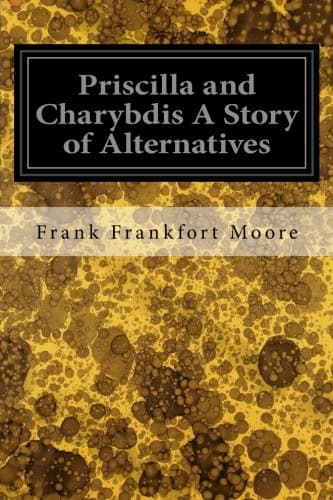
Priscilla and Charybdis: A Story of AlternativesMoore, Frank Frankfort
General
Priscilla and Charybdis: A Story of Alternatives
Moore, Frank Frankfort
Fiction
When she had gone away Priscilla wondered if there was anything in what
she had said on this point; and Jack replied that he was afraid that
Mrs. Bowlby-Sutherst was too notorious as a patron of notoriety for her
opinion to have much weight. But as things turned out, that was
just where he was wrong, for within the week several other ladies of
considerable importance--county importance--called at the Manor, and
were admitted. These were people who owned London houses and had a
premonition that next season Mrs. Wingfield--they were sure that
she would be Mrs. Wingfield by then--would be looked on as the most
interesting figure in the world of drawing-rooms; and Priscilla found
them very nice indeed, referring to her “case” as if it were one of the
most amusing jests of the autumn season. They showed no reluctance in
talking about its funniest features--its funniest features were just
those which a rigid disciplinarian would have called its most serious
features--and they promised faithfully that when she should appear in
the court they would be present to offer her their support--their moral
support. They seemed quite downhearted when she explained to them how
it was her hope that the arbitrament of the Divorce Division would be
avoided by a decree of a judge on the question of nullity. They had
quite set their hearts on the Divorce Court, and had in their eye
a toilet scheme which they felt sure would be in sympathy with the
_entourage_ of that apartment, and to which they thought they might be
trusted to do justice.
But as the social position of these visitors was among the highest in
the county, Priscilla began to feel that there was no chance of her
becoming isolated even at the Manor House. The reasonableness of her
attitude appealed, she saw, to some reasonable people. She had great
hopes that it would appeal as well to one or more of His Majesty’s
judges when the time came.
And she was not neglected by her dear friend Rosa Cafifyn; but this
young woman came to her unaccompanied by her mother. The Caffyn
household was divided against itself on this vexed subject of
Priscilla’s attitude. Mrs. Caffyn, who had never encouraged her
daughter’s friendship for Priscilla Wadhurst, was aghast at the
publicity which her daughter’s friend had achieved.
Public-domain text, read in full here on John Shaqi.
Reviews
Reviews
No reviews yet
Be the first to share your thoughts on this work.
Elsewhere in the archive
Join the Discussion
Join the discussion
Sign in to leave a comment or review.
Sign InorCreate an account