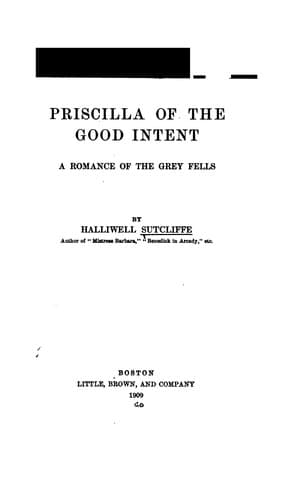
Priscilla of the Good Intent: A Romance of the Grey FellsSutcliffe, Halliwell
General
Priscilla of the Good Intent: A Romance of the Grey Fells
Sutcliffe, Halliwell
Country life -- Fiction; Courtship -- Fiction; England, Northern -- Fiction; Farm life -- Fiction; Mate selection -- Fiction
“That’s true,” assented the driver cheerily, after due consideration
of the point. “Be durned, David, ye’ve a gift o’ common sense. Thought
I had the gift, too, till I took to looking for mulberry patches i’
honest people’s faces.”
When they neared Shepston, the smith turned for a last look at the
hills raking up into the white-hot limestone glare that beat upon the
dale he loved.
“’Tis good-by, I reckon, lile lass Cilla,” was his thought.
Reuben Gaunt had not joined the company that met to give David a
farewell at the inn. With all his fickleness, he was not a liar, and
he disdained to make a show of friendship, when he knew that there was
open enmity. Instead, he remembered that it was Linsall Fair-day, and
he walked up the moor to Ghyll Farm.
Gaunt found the farm-door open, and stepped in. Peggy Mathewson was
busy baking bread, and she looked hot and tired. The heat of the
kitchen, the smell of the loaves, drove Gaunt into the shelter of the
porch again.
“Phew! I thought ’twould be cooler indoors than out, Peggy.”
“Did ye? My temper’s not cool, to begin with, Reuben--or should I say
‘Mr. Gaunt’ these days?”
“Reuben, I fancy.”
“I like to know. Ye change so often, and your station varies so--now
marrying proud little Good Intent, and then again bending down to take
notice o’ Peggy Mathewson--”
“I’ve a cure for your temper, Peggy,” he said, with an easy laugh.
“We’ll go to Linsall, and your loaves can wait.”
“Why to Linsall?” she asked, with a longing glance at the moor.
“Oh, ay, ’tis Fair-day. I’ve nigh forgotten fairs, and ribbons, and
sich-like idleness, since you came home again. What wi’ work, an’ what
wi’ trying to keep up wi’ your cantrips, Reuben, I’m a busy lass.”
He only laughed and switched his leggings with the riding-crop, which
from sheer habit he was carrying. The girl’s tongue might be bitter,
but her eyes told another tale. “Let’s away, Peggy. A scamper always
does you good. As for the baking--”
“It’s finished,” she broke in, setting down the last batch of loaves
from the oven; “and if it weren’t--why, I fancy I shouldn’t heed.”
The old recklessness was in her voice, the old longing for
light-heartedness, though under it all she knew that there was grief
and heaviness. She went up-stairs and was down again before Gaunt had
time to grow impatient.
“Shall I shame ye at the Fair?” she demanded, standing frankly for his
inspection, her colour heightened, her hands resting on her hips.
Reuben noted the red scarf, the touches of colour which she had
added deftly here and there to a dress which had seen many fairs and
many weathers. No other lass could have worn such colours. They were
gypsyish, bold, reckless, like Peggy herself, and they seemed to add to
her beauty and her self-assurance.
“Shame me?” laughed Reuben. “There’ll be eyes for none but ye at
Linsall!”
Public-domain text, read in full here on John Shaqi.
Reviews
Reviews
No reviews yet
Be the first to share your thoughts on this work.
Elsewhere in the archive
Join the Discussion
Join the discussion
Sign in to leave a comment or review.
Sign InorCreate an account