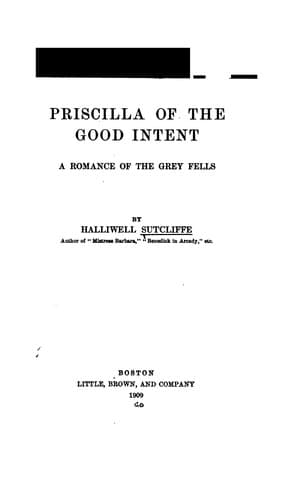
Priscilla of the Good Intent: A Romance of the Grey FellsSutcliffe, Halliwell
General
Priscilla of the Good Intent: A Romance of the Grey Fells
Sutcliffe, Halliwell
Country life -- Fiction; Courtship -- Fiction; England, Northern -- Fiction; Farm life -- Fiction; Mate selection -- Fiction
The widow’s face softened a little, but she did not spare him. “Very
well,” she said, her fine, keen eyes reading every line of his face.
“Ay, very well indeed, Reuben Gaunt, if ye can hold to th’ same mind
two days running. When I see Peggy wedded I shall believe ’at Peggy’s
wedded. Good night to ye. I’m fair clemmed wi’ all th’ day’s work,
while ye two were gadding ower to Linsall Fair.”
Peggy went with Gaunt to the gate of the croft. “Ne’er heed mother,”
she whispered. “’Tis her way, Reuben. She’ll soften to ye by and by.”
“I heed naught, lass, so long as ye’re lying lile and soft i’ my two
arms. What a fool I’ve been all these years--what a fool!”
He was swept away by his passion, by the girl’s free, reckless beauty
and reckless tenderness. He pictured her down yonder in the lonely
house at Marshlands. The liberty he had cherished--liberty to come and
go as he listed, like the wind--was shorn of all attraction. There
would be warmth and well-doing about his house, and ties to keep him
safe from wandering.
They stood looking down the moor. The moon outlined each smooth ridge;
her light was nestled in the misty vagueness of the hollows; away and
away to the grey-blue of the silent sky she touched the land with
witchery. And Peggy sighed.
“Why, lass, you’re shivering,” said Gaunt, roused from his dreams of
what might be.
“Oh, a goose walked over my grave,” she answered lightly. “A silly
goose, Reuben, to choose just to-day for wandering.”
She did not tell him that she feared the day’s happiness, feared lest
all should be changed when she woke on the morrow. Hardship was more
easy to believe in, after all, and in her experience it followed
pleasure always.
They watched the moor; and the tenderness, the mute, uncomplaining
sorrow of the land, came close to Peggy, as to one who had known the
heath from childhood.
“Reuben,” she sobbed, “if only ye had one mind in a day, instead of
fifty--or if only I could care for ye less--”
“Best care for me more instead of less,” laughed Reuben. “I’ve no
heed, myself, for geese walking over a grave.”
“It was silly, I own. There, ye’ve had kisses enough and to last--”
“Until to-morrow?”
“Well--maybe--if ye come not too early, while I’m milking the cows--or
not overlate, when the house will need looking to, after all the work
I’ve given mother to-day. There, Reuben--oh, there and there, if ye
must better one good kiss. Good night, Reuben.”
Gaunt swung down the moor. The moon stood silver-gold in the middle of
the blue sky. A sheep got up beneath his feet. He startled a grouse
from its bed among the heather. Far down below him he could see a light
set like a little star above the porch of Marshlands.
“They’re used to late home-comings o’ nights,” he laughed. “There’ll be
fewer such when Peggy comes to Marshlands.”
CHAPTER XVII
Public-domain text, read in full here on John Shaqi.
Reviews
Reviews
No reviews yet
Be the first to share your thoughts on this work.
Elsewhere in the archive
Join the Discussion
Join the discussion
Sign in to leave a comment or review.
Sign InorCreate an account