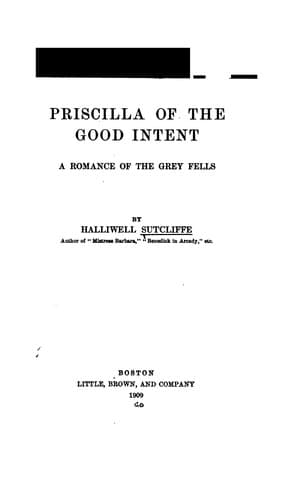
Priscilla of the Good Intent: A Romance of the Grey FellsSutcliffe, Halliwell
General
Priscilla of the Good Intent: A Romance of the Grey Fells
Sutcliffe, Halliwell
Country life -- Fiction; Courtship -- Fiction; England, Northern -- Fiction; Farm life -- Fiction; Mate selection -- Fiction
Gaunt bought the mare for Peggy, and gave orders that it should be
sent that day to Marshlands; but he had little heart either in the
bargaining or the purchase. As he walked up the High Street toward the
inn again, a hearse was moving slowly to the churchyard which fronted
and looked down upon the road. They told him that only one day of the
last fifteen had passed without a burial, and some days there had been
three or four. It was brought home to him at last that the Black Fever
was no boggart invented by mothers to frighten wayward bairns; he saw
the scourge now as it really was, as a pestilence unlike all others,
save the plague which many hundred years ago, folk said, had destroyed
whole villages, and had made thriving townships into wasted hamlets.
Indeed, the fever, in a less degree, had that power to weaken men by
terror which the plague had had long since. It was market-day, and
a busy day, along the High Street; but uneasiness and gloom showed
plainly on all but the most reckless faces, and farmer-men, ashamed of
a weakness they could not control, would glance at farmer-men, seeking
for the telltale patches of mulberry-red which spelled infection.
Gaunt opened his lungs to the breeze when he was clear of Shepston. He
knew that there was danger to himself, but had dismissed the thought;
his cowardice was all for Peggy. He was glad to be out among clean
fields again, with the open road in front of him, and none to talk of
the fever.
He walked straight up to Ghyll Farm after reaching home, and Peggy
was standing at the gate of the croft, looking down the moor. She
half looked for him, and for that reason had fastened the crimson
handkerchief round her throat; she had tied and untied it before her
cracked mirror, with the honest coquetry which a woman finds when she
knows that one man only has a claim on it.
Reuben saw the scarf, as soon almost as he caught sight of the waiting
figure. The sunlight, stark and dry as the fields it had scorched,
caught the warm colour of the kerchief.
“You look tired, Reuben,” said Peggy o’ Mathewson’s, after a quiet
glance at his face.
“Well, yes,” he answered carelessly. “It was a hot drive into Shepston,
and the fools would talk of nothing but their fever. I begin to think
they’re proud of it, Peggy.”
“They’ve got used to it, you see,” said the girl, with something of her
mother’s tart knowledge of the world. “’Tis queer, Reuben, how soon
ye get used to a thing, even if ’tis bad, and seem to miss it when it
goes.”
He scarcely heard her. His eyes were fixed on the crimson scarf, and
she smiled happily as she followed his glance.
“Yes, I’m wearing your gift, lad. Mother chided me just now--said ’twas
no sort o’ fancy-stuff to wear, when there were cattle needed milking
by and by. I said you’d given it me at Linsall Fair and the lile, soft
beasts would milk no worse because I wore it.”
Public-domain text, read in full here on John Shaqi.
Reviews
Reviews
No reviews yet
Be the first to share your thoughts on this work.
Elsewhere in the archive
Join the Discussion
Join the discussion
Sign in to leave a comment or review.
Sign InorCreate an account