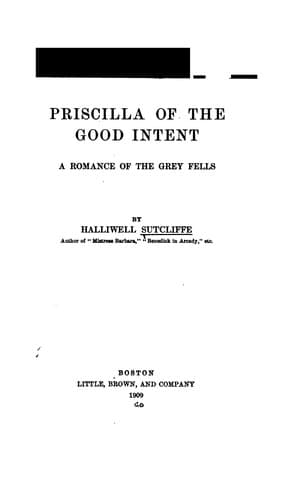
Priscilla of the Good Intent: A Romance of the Grey FellsSutcliffe, Halliwell
General
Priscilla of the Good Intent: A Romance of the Grey Fells
Sutcliffe, Halliwell
Country life -- Fiction; Courtship -- Fiction; England, Northern -- Fiction; Farm life -- Fiction; Mate selection -- Fiction
“Ye were in your cradle then,” she said, “an’ knew naught on’t, though
it carried your mother off. Reuben, if ye ever want to know what flimsy
stuff we’re made of, high and low, good ’uns an’ bad--ye’ve got to
look on at a fever-time. Th’ fear seems more catching than th’ fever
itseln, an’ always th’ big, hearty men catches it worst. Oh, the sights
that come back to mind! Thirty-and-four year ago it war, and all comes
back as plain as Peggy’s moanings up aboon us yonder.”
Gaunt saw that it eased her to talk of olden days. The man had grown
gentle, considerate. He was full of this new experience of thinking for
others, rather than himself.
“Tell me about them, mother,” he said.
“Oh, there’s no use i’ telling. Ye need to have seen it--as ye will
do, happen, if ye’re spared--to know the muckiness o’ fright. Ivery
house war a island to itseln. Men who’d faced bulls run mad at Shepston
market-day, men who’d risked crossing the bogland at dark o’ neet, to
bring comfort to a friend,--where were they, Reuben? Hugging their own
firesides. Not a drop o’ milk could the poorer sort get--and milk was
needed, ye’ll be sure, i’ the stricken cottages--for a watch was kept
at th’ farm-gate, an’ they were fended off afore they could bring their
pitchers nigh.”
The widow talked of things she had seen long ago with clear
unfrightened eyes. She would pause to light her pipe, and then would
fall into a friendly silence, taking up the tale again at leisure. For
she knew that, however it went with Peggy, there would be time and to
spare for talk with Reuben.
“I’ve heard young folks shiver an’ shake when small-pox was so much
as named. Bless ye, I’ve seen worse nor small-pox. It may spoil
your face--an’ what day of a hard life doesn’t help to spoil your
looks?--but there’s a chance of living on. There’s the rub, lad! ’Tis
when ye set folk face to face wi’ what’s all but certain death, that
ye know what they’re made of. There’s rum i’ the cupboard, Reuben. I’m
forgetting what manners I iver had.”
“No, and thank you, mother. Not just to-night.”
The widow got up and set glasses and a bottle on the table, and took
down the kettle from the crane hanging over the peat-fire.
“Don’t you go too far wi’ godliness all at once, Reuben,” she said,
with a flash of her old tartness. “Ye’re not going to save Peggy by
keeping a drop o’ liquor out o’ ye, but happen ye’ll let the fever in
by playing the miser that way.”
Gaunt had been right when he said that the widow could never have borne
her loneliness without a man to help her. Already she was gentler than
he had known her. She jested about the measure of rum she shared with
him, saying that he led her into bad ways. She had found that interval
of peace which sometimes comes to folk in the bitterest of their
trouble; and those who have lived long, and suffered long, say that it
is God’s breathing-space, granted to brave folk lest their courage fail
them at the pinch.
Public-domain text, read in full here on John Shaqi.
Reviews
Reviews
No reviews yet
Be the first to share your thoughts on this work.
Elsewhere in the archive
Join the Discussion
Join the discussion
Sign in to leave a comment or review.
Sign InorCreate an account