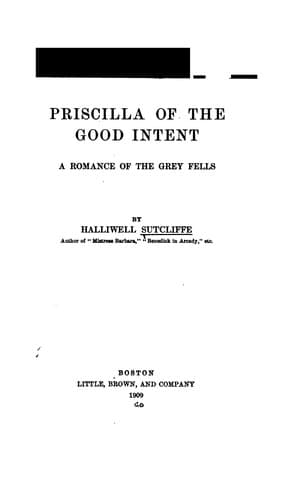
Priscilla of the Good Intent: A Romance of the Grey FellsSutcliffe, Halliwell
General
Priscilla of the Good Intent: A Romance of the Grey Fells
Sutcliffe, Halliwell
Country life -- Fiction; Courtship -- Fiction; England, Northern -- Fiction; Farm life -- Fiction; Mate selection -- Fiction
Widow Mathewson had always been fearless in her outlook, whether it
were true or false, and she did not yield. “I don’t laugh at ye, lad,
but such softnesses were never meant for Peggy and me. ’Tis all very
weel i’ the tamer lands, but not up here. She lived as she lived, an’
she died as she died, and naught alters that. God rest her soul, say
I--but that’s as she made her bed i’ this life. Reuben,” she went on,
abandoning all her hardness again, “I’ve done a deal o’ thinking about
religion i’ my time, an’ never come much nearer aught. Ye might tell
me that Peggy did as weel i’ this life as could be expected of a body?
Now, there, I’m growing old, or I’d not give way to whimsies. Reach
down my pipe for me, Reuben; ’baccy alwus helps me to get right sides
up wi’ the world again.”
Gaunt, the ne’er-do-weel, felt an odd thrill of comfort in ministering
to this hard-faced woman who depended on him. He filled her pipe for
her, and he lit a spill at the fire.
“That’s better,” she said, drawing long puffs of smoke. “There’s a deal
to be done, and there was never use i’ blinking work. For myseln, it
matters naught either way; but for ye, Reuben--well, ’tis best to get
fever out of a house as quick as may be. It wouldn’t help a living soul
if silly Nathan stepped up and caught th’ fever, or if parson came, and
he’s one o’ the few i’ Garth who would. Parson is staunch, for all he
thinks me heathenish. Ye’ve faced a good deal, Reuben; surely, ye’ll
help me to keep fever out o’ Garth?”
Gaunt moved uneasily about the room. He would have had another kind of
burial, but there was no gainsaying the other’s wisdom. The village, so
far, had escaped contagion; his own feelings must stand aside, surely,
when measured by the terrible price which Garth might have to pay for
them.
“We have no right to do aught else,” he said, turning to meet the
widow’s glance. “See, mother, she always had a liking for the spot
where the rowan hangs over the stream. I’ve been thinking she might
wish to be laid there.”
The widow nodded. “Get to your work, Reuben,” was all she said. “It
doesn’t do to sit idle at such-like times.”
Something near to peace came to Gaunt when he reached the little ghyll
and stood watching the stream, all but dry now, trickle down the rocky
slope under the rowan. It seemed that, after all, Peggy would sleep
more soundly in her own homeland than in another place.
The peat lay soft and deep almost down to the edge of the stream, and
there was little trouble in the digging. With a touch of that fugitive
poetry which was part of the man, he conquered his horror of the work.
He told himself that she would like to have the stream-song close
beside her, day and night. Death would not be a sleep and a forgetting,
but a sleep that remembered all the pleasant moorland haunts. And the
rowan-leaves would shelter her from heat in summer, and in winter-time
the peat would lie between Peggy and the wildest storms that blew.
Public-domain text, read in full here on John Shaqi.
Reviews
Reviews
No reviews yet
Be the first to share your thoughts on this work.
Elsewhere in the archive
Join the Discussion
Join the discussion
Sign in to leave a comment or review.
Sign InorCreate an account