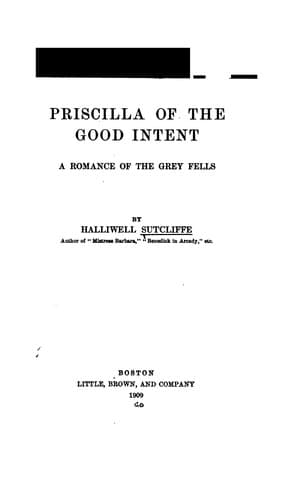
Priscilla of the Good Intent: A Romance of the Grey FellsSutcliffe, Halliwell
General
Priscilla of the Good Intent: A Romance of the Grey Fells
Sutcliffe, Halliwell
Country life -- Fiction; Courtship -- Fiction; England, Northern -- Fiction; Farm life -- Fiction; Mate selection -- Fiction
It was in this way that she chose to meet the future. There would be no
more stolen vigils under the rowan-tree, no undermining of her courage.
With a sudden gust of feeling, she understood that Gaunt was the only
living hope she had to rest upon--and there was danger to him.
“Reuben,” she said gravely, “th’ long watch has begun. The days will
seem long i’ passing afore we know we’re safe.”
“We’ll weather them, never fear. Best not think of to-morrow at all,
but get on with our work.”
The widow glanced at him with keen scrutiny. “There’s a deal o’ sense
hidden somewhere about ye, Reuben. Seems ye’ve been feared to let it
peep out till now.”
CHAPTER XXI
Neither Gaunt nor Widow Mathewson was prepared for the quiet and
temperate beauty that crept into their waiting-time at Ghyll. If Gaunt
had neglected his farm work in old days, it was through idleness, not
from lack of knowledge. Acquaintance with all details of field and
stable had been bred in him, and the widow watched him go about the
usual round of work with growing wonder.
“A hired man would have done half as much i’ the day, and done it
badly,” she said, finding him milking the cows one evening.
“Oh, ’tis only the old proverb, mother, the master-man always works the
better if he has the will. ’Tis not often that he has the will, ye see.”
She watched him persuade the last of the cows to be friendly with
the milking pail, listened awhile to the pleasant splash-splash of
the milk. “Reuben,” she said, with a touch of jealousy, “yond’s the
sauciest beast o’ them all, and ye seem to have her at a word. She
wouldn’t let any but me milk her--not even Peggy, though she’d deft
hands at the udders. And, Reuben, ye’re doing too much. Leave some bit
o’ work for me to do, lest I get thinking o’ what’s past and done with.”
“We’ll share and share alike,” said Gaunt, looking over shoulder from
his seat on the milking-stool.
“Some folk have queer notions o’ sharing. I tell ye, I’ve not been so
idle o’ my hands sin’ I war a girl.”
“All the better, mother. You’ve earned a rest by this time, while
I--perhaps I’ve earned a spell of work,” he broke off, with something
of the widow’s own grim humour.
The busy needs of the farm were already helping these two to forget
their burden. To Gaunt it seemed strange, profane almost, that sorrow
for the dead should give place to workaday anxieties; to the widow, who
was older in experience, it was plain that such work brought with it
the gift of healing.
All the routine at Ghyll was interrupted. It had thrived on its trade
in milk, and cheeses, and butter. Now Widow Mathewson, and Gaunt, and
the three pigs fattening in the stye at the far side of the mistal,
were left to drink what they could of milk that once had supplied half
Garth’s needs; the rest, save what was needed for their own week’s
butter-making, had to be poured out into the parched and thirsty croft.
Public-domain text, read in full here on John Shaqi.
Reviews
Reviews
No reviews yet
Be the first to share your thoughts on this work.
Elsewhere in the archive
Join the Discussion
Join the discussion
Sign in to leave a comment or review.
Sign InorCreate an account