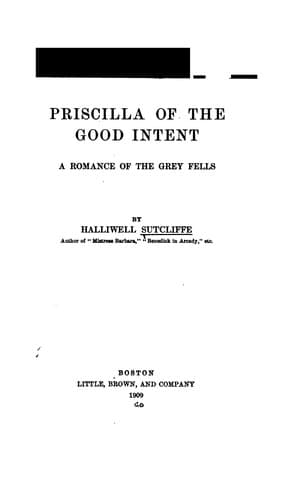
Priscilla of the Good Intent: A Romance of the Grey FellsSutcliffe, Halliwell
General
Priscilla of the Good Intent: A Romance of the Grey Fells
Sutcliffe, Halliwell
Country life -- Fiction; Courtship -- Fiction; England, Northern -- Fiction; Farm life -- Fiction; Mate selection -- Fiction
The moon lay young, slender as a sickle, over the parched lands of
Garth. Cilla herself, as she stood in the roadway, looked cool and
slender, too, in her white gown, though she was full of strange
disquiet. Her modesty had taken fright. It was well enough to be
anxious for Reuben’s safety, well enough to seek news of him as often
as she could; but she knew that it was more than friendship, this
restless eagerness for news. And Peggy o’ Mathewson’s should have been
a bride by now; and the peat was scarcely smoothed above her grave.
Cilla, for all her daintiness, her love of clean thinking and clean
doing, was human as her neighbours, and subject to those gusts of
warm and reckless feeling which are apt to scatter the habits of a
lifetime. If she had been told of another who waited, as she had done,
for news of a bridegroom widowed before his wedding-day, she would have
thought lightly of her. Yet she could only picture Reuben up at the
lonely, hill-top farm; could only pray for his safety and know that her
prayers came from a warmer heart than she ought to carry.
She turned instinctively to Good Intent. Her father would be sitting
by the hearth, big of his body, big in charity. She would step in, and
have a talk with him.
The yeoman was sitting in his chair, as she had pictured him. But
his pipe lay cold in his hand, and he motioned her to a seat in the
settle-corner opposite.
“Cilla, I’ve had a talk or two with the doctor,” he began.
She waited, suppressing a quiet laugh that he, too, had gone out for
stolen interviews with the lay priest at Garth.
“It seems Gaunt chose to go in to Ghyll Farm and to stay there. He knew
what it meant before he crossed the door-stone. I wouldn’t believe it,
until the doctor told me it was so.”
“Yes, father.”
“Well, be durned if I’d have done it.”
“Oh, yes; oh, indeed, you would have done it, father; ’tis the sort of
call you’d have answered, but it was not asked of you.”
“Fiddle-de-dee,” said the yeoman. “Black Fever would always scare me.
Give me a runaway horse, and I’ll handle the reins--but the fever--’tis
a waiting game, lile Cilla, and I could never play such. I’ve a sort of
envy, like, for men who can.”
Priscilla lit a spill for his pipe. She filled his glass for him, and
set it by his side. And then she waited.
“Seems I’ve treated Gaunt amiss,” said her father by and by.
“All folk do in Garth.”
“Ay, they did; but I was down i’ Shepston to-day, and they had the
news, and folk were puzzled. They fancied that Gaunt was better nor
like--in fact, Cilla, they seemed minded to turn their faces about and
overdo their praising of him.”
Cilla spread her hands to the peat-glow, and her face was full of
tenderness. “I told you so i’ the spring, father, but you would not
listen.”
The yeoman was uneasy. Praise was due to Gaunt, and yet he distrusted
the man. “He comes of a bad breed, Cilla, and I’m farmer enough to know
that ye don’t rear good stock from such.”
Public-domain text, read in full here on John Shaqi.
Reviews
Reviews
No reviews yet
Be the first to share your thoughts on this work.
Elsewhere in the archive
Join the Discussion
Join the discussion
Sign in to leave a comment or review.
Sign InorCreate an account