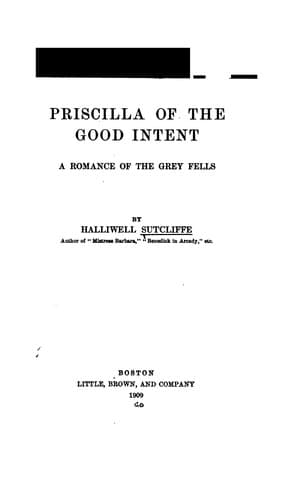
Priscilla of the Good Intent: A Romance of the Grey FellsSutcliffe, Halliwell
General
Priscilla of the Good Intent: A Romance of the Grey Fells
Sutcliffe, Halliwell
Country life -- Fiction; Courtship -- Fiction; England, Northern -- Fiction; Farm life -- Fiction; Mate selection -- Fiction
The sickle moon climbed up that night till it lay over Ghyll Farm,
that sheltered tired folk who slept. It lay, too, over the rowan that
sheltered one whose weariness was over and done with. On the moor,
where the thin stream trickled down, whispering a prayer of peace
to Peggy as it passed her grave, there was the keen breath of life
again. First, the moon was shrouded; then clouds as grey and slight as
gossamer came drifting up the breeze; and after that a little wind got
up, piping thin and high like a plover tired with the long day’s flight.
It was very still on the moor, save for the soft, insistent crying of
the wind. A wayfarer, had he been crossing the untilled acres, might
have heard God walking in this sweet and untamed wilderness. The
wind, slight as it was, was full of perseverance, and it began now to
shepherd running vanguards of the mist across the heath.
At three of the morning there was neither moon nor sky to be seen. A
wide sheet of mist, wet to the touch, hid every landmark of the moor,
which, until an hour ago, had shown plainly all its jagged hillocks,
its raking hill-top lines. And dawn, when it came, could do no more
than thread the mist-banks through with tints of silver-grey.
Gaunt, soon after daybreak, woke from his sleep on the long settle,
with instinctive knowledge that another day’s glare had to be faced,
and crossed to the window. At first he thought himself mistaken in the
hour, so dark the room was. Then he unbarred the door, and went out
into the mist. He felt its fingers wet about his face and hands; he
drew deep breaths of it as men drink in the first spring warmth after a
hard winter. Then he laughed, not knowing why, and leaned against the
house-wall, and was glad to rest awhile, with this sense of peace and
freedom sheltering him closely as the mist itself.
The physical relief, the sense of damp and freshness after long heat,
were part only of a deeper change. His fever-dread had left him; he no
longer felt the wearing need to hold his courage tightly, step by step
through the day’s up-hill climb, lest it fail him at the pinch.
“Oh, God be thanked,” he murmured, and went indoors, and called up the
stone stairway: “Mother, I’ve news for you!”
The widow had slept later than her wont, but she was awake in a moment.
“What is it, Reuben?” she answered, fearing disaster always when an
urgent summons came.
“The blessed rain is coming. We’ll have cloudy skies again.”
“Now, there’s a ha-porth o’ nonsense to fetch a body out of her bed
with,” grumbled the other. “’Tisn’t dawn, Reuben, surely; winter-dark,
I call it.”
“Come down and see, mother.”
Public-domain text, read in full here on John Shaqi.
Reviews
Reviews
No reviews yet
Be the first to share your thoughts on this work.
Elsewhere in the archive
Join the Discussion
Join the discussion
Sign in to leave a comment or review.
Sign InorCreate an account