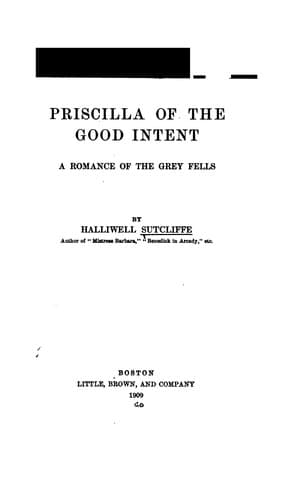
Priscilla of the Good Intent: A Romance of the Grey FellsSutcliffe, Halliwell
General
Priscilla of the Good Intent: A Romance of the Grey Fells
Sutcliffe, Halliwell
Country life -- Fiction; Courtship -- Fiction; England, Northern -- Fiction; Farm life -- Fiction; Mate selection -- Fiction
Little by little, however, memory of the panic grew dulled. Ten days of
rain, with scarcely an hour’s cessation now and then, were followed by
exquisite, crisp sunshine, till Yeoman Hirst declared that the face of
the land “looked as clean-washed as a babby’s.” The breeze was sweet
and nutty to the smell. Flowers, checked till now by the drought, began
to show out of their proper season, while September’s natural brood
stirred into blossom in every field and hedgerow. It was a season such
as puts new heart into men, whether they admit the weather’s influence
or make pretence of denial.
The fever, too, had spent itself. In Shepston there was a case here and
there, at longer and longer intervals, but none further up the dale.
“Oh, I don’t want to boast,” said Hirst to Cilla, on one of these
clean autumn evenings, as they watched the sun go down, “but it seems
like as if th’ fever couldn’t bid to touch bonnie Garth. ’Twas afraid
to spoil her face, I reckon.”
“There, father!” laughed Cilla, with that pleasant linking of her arm
in his which was full of comradeship. “I believe ye love Garth village
better than any soul that lives in it.”
“Well, no,” answered the yeoman, his voice rising to a roar of
affectionate good-will. “There’s ye, Cilla, lass--but Garth runs a good
second, I should say.”
Cilla was quietly happy these days, though she would admit no reason
for it. On every side she heard guarded praise of Reuben; for the
doctor, who seldom spoke ill of a man, was fond of spreading good
reports abroad when honesty allowed it. It was known now in Garth, not
only that Reuben had chosen to go into Ghyll and share its troubles,
but that afterwards they had done all they could, he and the widow, to
keep the plague from spreading down to the valley.
Priscilla did not ask herself why praise of Reuben was so welcome.
She simply let the gold, September days drift by, and sometimes cried
o’ nights when she thought of Peggy o’ Mathewson, sleeping beside
the moorland burn. It was Cilla’s way to cry for others when her own
happiness took shape.
At Marshlands, maybe, the servants, all save Michael, the head man,
relished the changed outlook upon Gaunt less than their neighbours did.
They found the master more intent on details of the farm and house than
he had been; he went roaming, for a day or two, or a week, less often,
and they were not free to drive Michael wild with their taunt of:
“Well, th’ master idles all his time; why shouldn’t such as us?”
“The fever’s gone to his head, though he thought he’d ’scaped it,”
said the housekeeper sagely to Rachel, the dairymaid, as she watched
the butter-making. “I was allus telled it left its marks on a man, did
fever.”
Public-domain text, read in full here on John Shaqi.
Reviews
Reviews
No reviews yet
Be the first to share your thoughts on this work.
Elsewhere in the archive
Join the Discussion
Join the discussion
Sign in to leave a comment or review.
Sign InorCreate an account