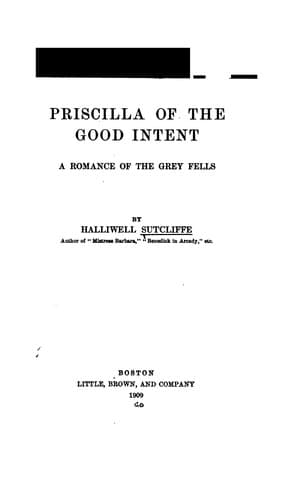
Priscilla of the Good Intent: A Romance of the Grey FellsSutcliffe, Halliwell
General
Priscilla of the Good Intent: A Romance of the Grey Fells
Sutcliffe, Halliwell
Country life -- Fiction; Courtship -- Fiction; England, Northern -- Fiction; Farm life -- Fiction; Mate selection -- Fiction
“Just so.” His pride was touched in some unexpected way. “They call a
fresh fiddle-tune, but are they sure I’ll dance to it?”
Cilla liked his stubbornness, liked the gravity which was so far remote
from her earlier knowledge of him. They said good-by in Raindrift
Wood, and Gaunt went slowly home, wondering that Cilla and he could
meet, not like lovers who had walked the field-ways when spring was
warm and urgent, but like friends who were old and tranquil as this
month of gold September.
At Marshlands, only Michael had faith in the master’s purpose; the
others said that he would tire of farming in a week or two more,
because it stood to reason that running water must be gadding off
somewhere or another.
Michael’s face grew cheerier as the days went on. He saw the master
keeping close at home; he saw the dairy-work grow cleanlier, the maids
and the farm-lads doing a day’s work in a day, instead of taking two to
it. Michael felt no jealousy. He had always had the farm’s interests at
heart, and had known that he could not rule the house until the master
set his own back to the work of supervision and ceased from wandering.
Reuben went his own way, as he had always done; but the new way, he
admitted to himself, rang more crisply underfoot than the old had done.
Folk were anxious in Garth village to show him that they knew and
understood what he had done at Ghyll; they were met by an easy courtesy
that was cold as an east wind, a courtesy that halted for a moment to
talk of the weather, and then passed by without a wish for friendship.
Reuben was plainly minded not to dance to their new tune as yet, and
they liked him the better for it.
He had found self-confidence. His father’s history, remembrance of that
bitter night, when, a lad of fifteen, he had seen Billy and his mother
driven out into the wind, had haunted him persistently, had lain always
in the background of his thoughts. He had grown used to the belief that
his by-name fitted him well enough, that he was infirm of will and must
be so to the end. There was no claim upon him, save the farm’s; and
that claim had been too abstract and impersonal until now to move his
fancy.
“’Twill not last,” he would think, coming home at nightfall from some
journey over the pastures. “But at the worst, it can do no harm, and
keeps me busy.”
As the days went by, he grew more full of wonder at the change in
himself. Little by little the lands, and the smaller of the farms, and
his own big house of Marshlands, crept into his heart, as a child might
creep to the knee of a lonely man and bring him soft companionship. He
had neither wife nor child of his own; and, lacking these, a man’s best
solace is love of the acres left him by many generations.
Public-domain text, read in full here on John Shaqi.
Reviews
Reviews
No reviews yet
Be the first to share your thoughts on this work.
Elsewhere in the archive
Join the Discussion
Join the discussion
Sign in to leave a comment or review.
Sign InorCreate an account