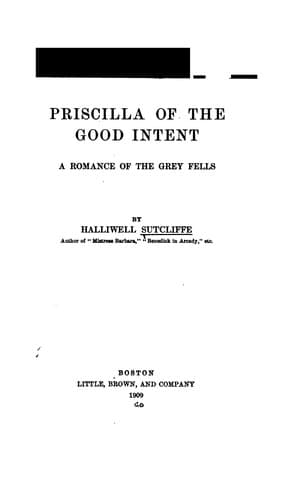
Priscilla of the Good Intent: A Romance of the Grey FellsSutcliffe, Halliwell
General
Priscilla of the Good Intent: A Romance of the Grey Fells
Sutcliffe, Halliwell
Country life -- Fiction; Courtship -- Fiction; England, Northern -- Fiction; Farm life -- Fiction; Mate selection -- Fiction
It was to be the bitterest winter known for fifty years in Strathgarth.
Yet, when December came, and the frost strengthened its grip, and all
the land began to wear a pinched and sullen look, Gaunt felt the warmth
of life increase. He lost his dogged recollection of former slights
when meeting his neighbours at market or along the highways, just as
they had long been willing to admit that their settled judgment of a
man might, for once, be wrong. They heard his laugh less often now, but
it was heartier when it came, and one they liked to hear. By gradual
stages he was settling into his true position as master of the biggest
and the oldest farm in Garth.
Hard work was asked of him that winter. Before Christmas there was a
three days’ snow that drifted over every sheep ungathered from the
higher lands. When his own ewes were recovered--and he took more than
his share of a labour asking great patience and endurance--he made his
way as best he could to Ghyll Farm, getting along by the wall-tops
mostly, to see how Widow Mathewson was faring.
He found her helping the man to clear the last fall of snow away
from the space between the house-front and the well; her cheeks were
ruddy, and her voice rang crisp and almost merry, when she saw Reuben
struggling through the croft.
“Bless me, but this has been what parson would call a visitation!” she
cried. “’Tis sweeping we’ve been, an’ sweeping all ower again an hour
or two after; we’d have lost our way to the well-spring if we hadn’t.
It was kind o’ ye to come, Reuben. You’d no easy journey, I reckon, up
th’ moor. It must hev been like climbing a feather-bed set on end.”
“So it was, mother, when the walls didn’t help me; but I’d a fancy you
might need me.”
“Now had ye?” said the widow crisply. She was always apt to lose ten
years of her sorrow when fighting one day’s inclement weather. “Because
o’ my sheep all overblown up the moor? Ye should never waste pity,
Reuben; there’s little enough about, and ’tis precious, like.”
“You have them safe, then?”
“Safe? I learned farming while ye were i’ your cradle, and that means I
learned weather, too. We’d a lile soft spell o’ warmth last week? And
ye never dreamed it meant snow to come?”
“I didn’t,” Gaunt admitted. “I fancied an open spell was coming.”
“And you bred i’ Strathgarth, and to know so little of her whimsies!
That’s how she fools ye every winter--a bout o’ cold that starves the
marrow i’ your bones, and then a week o’ softness just to ’tice ye on.
Oh, I’m old to Strathgarth, lad; and soon as ever the warm snap came,
I says to lad Michael here: ‘Michael,’ I says, ‘we’ll gather the ewes
under shelter.’ And Michael, being young and a man, and a bit daft,
says ‘no.’ And I says ‘yes,’ and had to threaten to clout his lugs
before he found persuasion. A few folk find religion, Reuben; but ’tis
persuasion finds the many.”
Public-domain text, read in full here on John Shaqi.
Reviews
Reviews
No reviews yet
Be the first to share your thoughts on this work.
Elsewhere in the archive
Join the Discussion
Join the discussion
Sign in to leave a comment or review.
Sign InorCreate an account