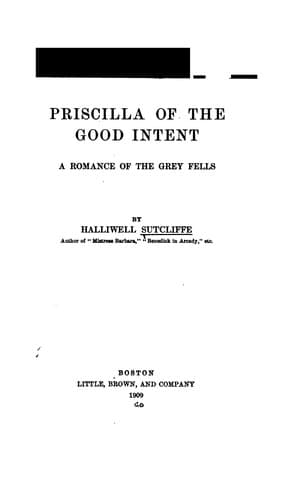
Priscilla of the Good Intent: A Romance of the Grey FellsSutcliffe, Halliwell
General
Priscilla of the Good Intent: A Romance of the Grey Fells
Sutcliffe, Halliwell
Country life -- Fiction; Courtship -- Fiction; England, Northern -- Fiction; Farm life -- Fiction; Mate selection -- Fiction
“I’ve travelled so far,” he said, more to himself than to Hirst; “and
she’s a stay-at-home most days o’ the year, and I fancied she’d be
about the place just this one day.”
“Oh, tuts! She’ll be back i’ a few hours’ time, David. No need to go
thinking the end o’ the world is coming because a lass is doing some
bits o’ business for her father.”
Hirst, with all his cheeriness, was ill at ease. He knew that this
man’s dream would not come true; he felt that a hint in time would be
kindly, and yet he shrank from giving pain. In his indecision he turned
slowly down the croft, and David followed him.
“Why, that’s Cilla’s voice!” cried the yeoman, halting suddenly. “She’s
home before her time; and how she’s managed it beats me, for the mail
isn’t due for an hour yet.”
And David watched the white highway below, where it came out of the
shelter of the trees and curved past Good Intent. He felt sick and
helpless.
Then he saw her, for the first time in the months that had seemed years
in passing. Gaunt and she stepped into the road, as if they owned it
and the whole, round world besides. She was wearing the lilac gown, but
it had not been donned for David the Smith. They passed out of sight
toward the porch of Good Intent; and, because they were looking at each
other, they did not see the two men in the croft above.
“Well, you’ve got your wish,” said Hirst, bewildered by the misery in
David’s face, and trying still to believe in his old creed that all
would yet go well with everybody. “We’ll step down, David, lad, and
Cilla shall give you tea of her own brewing, and--”
“Thank ye,” said David heavily, “but I’ll be getting down to the forge.
That’s where my heart will have to bide from now on, and I might as
well make a beginning.”
The yeoman watched him go. “Oh, bless me,” he muttered ruefully, “I do
like to see things go right for all. Pity I hadn’t two lile Cillas,
i’stead o’ one, if David’s bent on breaking his heart like any raw
young lad.”
A busy hum sounded from the forge as David neared it. Not many weeks
ago the fire-glow had lain across the road, a crimson splash on the
white April snow; now it fought for mastery with the clear, hot
sunlight. David lifted his head when he heard the rhythmical song of
the bellows, as an old fox-hound rouses himself when music of the pack
sounds down the wind. The blow had fallen on him mercilessly; but
already he felt heartened a little, a very little, by the sturdy light
of the forge. He stepped to the doorway, and looked in. Dan Foster’s
lad was working the bellows, and Billy was playing at smithy work.
David watched the man’s muscles tighten and relax, relax and tighten,
as he plied his hammer; and an off thought came to him that the world’s
work would be better done if more folk played as Billy did.
Public-domain text, read in full here on John Shaqi.
Reviews
Reviews
No reviews yet
Be the first to share your thoughts on this work.
Elsewhere in the archive
Join the Discussion
Join the discussion
Sign in to leave a comment or review.
Sign InorCreate an account