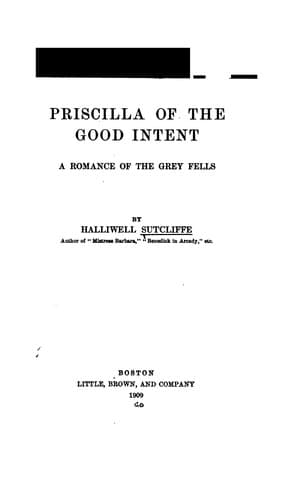
Priscilla of the Good Intent: A Romance of the Grey FellsSutcliffe, Halliwell
General
Priscilla of the Good Intent: A Romance of the Grey Fells
Sutcliffe, Halliwell
Country life -- Fiction; Courtship -- Fiction; England, Northern -- Fiction; Farm life -- Fiction; Mate selection -- Fiction
The smith had lit his own pipe, and was listening with something of
the old content to Billy’s familiar line of thought. All the fool’s
interest in life, trace it deep enough, centred round growth of some
kind. It might be growth of the plants under sheltered banks, that
caught the first footsteps of the spring, which claimed attention from
him; it might be the mother-work of birds when they hatched their eggs
in the many nests he over-watched, or the whitening of the pastures
when ewes began to drop their lambs; it might be the forging of an iron
rail, or the building of a wall; but the instinct at the root of all
his pleasures was growth. Untrammelled, as no other man in Garth was,
by the frets and small indignities of daily life, Billy had learned
insight into the deeper truths. He could write no verses, nor wished
to; but he moved through the quiet village life, for all that, a great
poet, not of his own dales only, but of the world.
David’s nature was akin to his in many ways, and at times such as
this, when Billy let his heart peep out and showed why toil was play
to him, the smith was apt to feel a touch of awe, as if he listened to
a greater than himself who was talking of eternal verities. The next
moment Billy would lose his high, abstracted look, and would return to
some foolish detail of the world about him. He did so now.
“I’ve your money all ready for ye, David,” he said, going to the far
corner of the smithy and reaching down a small, square box from the
shelf. “Made the box myself, soon as ever ye left Garth, and made a
slit, I did, big enough for money to go through, but not for fingers.
Te-he, David! Not for fingers, I reckon.”
David was puzzled as the other jingled the coins as he crossed the
floor, and placed his money-box in the smith’s hands. “What is all
this, Billy?” he asked.
“Play money,” said the fool impassively. “Ye see, David, I’ve no more
use for coins than for pebbles i’ a stream, so I saved ’em up against
your home-coming. Charged terrible high prices, I, for shoeing a horse;
and folk laughed, and they paid it, they did, because ’twas only Fool
Billy; and there’ll be a right proper nest-egg ready for ye, David.”
The tears were in David’s eyes at last. He had gone on a wasted errand
to another land, and had returned empty of thanks and pocket; he had
come cheerily home, ready to start afresh with strong hands and a clean
conscience as his only capital, and had encountered Widow Lister and
her anxiety touching a tin kettle borrowed years ago. He had looked
down from Hirst’s croft at a strip of sunlit highroad, and had seen a
pair of lovers, full of spring’s tender insolence and right-of-way.
All had slipped from under his feet, all save Billy the Fool, whose
pleasure, like his own, was to give--always to give, asking no return,
claiming only a pipeful of tobacco at the day’s end, and a tranquil
smoke over the morrow’s gifts to other folk.
Public-domain text, read in full here on John Shaqi.
Reviews
Reviews
No reviews yet
Be the first to share your thoughts on this work.
Elsewhere in the archive
Join the Discussion
Join the discussion
Sign in to leave a comment or review.
Sign InorCreate an account