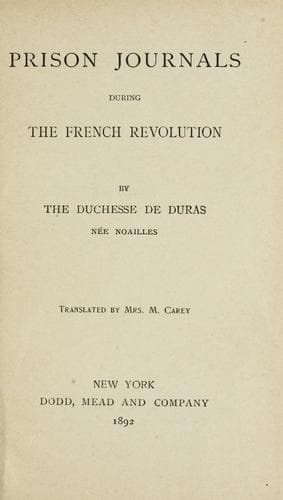
Prison Journals During the French RevolutionDuras, Louise Henriette Charlotte Philippine (de Noailles) de Durfort, duchesse de
History
Prison Journals During the French Revolution
Duras, Louise Henriette Charlotte Philippine (de Noailles) de Durfort, duchesse de
France -- History -- Revolution, 1789-1799 -- Personal narratives
At this point there is an open place, and several streets enter into
it. The storm was at its height, and the wind had grown more violent.
The ladies in the first wagon were much disturbed by it, especially the
Maréchale de Noailles; her large cap was thrown back, and showed her
gray hair. They tottered upon their rough plank seats, their hands
being tied behind their backs. Immediately a crowd of men, who were
there in spite of the rain, recognized her, paid attention only to her,
and by their insulting cries increased the tortures which she was
supporting with patience. 'There she is,' they cried, 'the Maréchale
who went in such style, driving in her fine carriage,--there she is in
the cart, just like the others!'
The cries continued; the heavens grew darker and the rain more violent.
We reached the street crossing just in front of the Faubourg St.
Antoine. I went forward, looked around, and said to myself, this is the
best place to afford them what they so much desire. The cart was going
more slowly; I stopped and turned toward them. I made a sign to Madame
de Noailles which she entirely understood: 'Mamma, Monsieur Carrichon
is about to give us absolution.' Immediately they bent their heads with
an air of repentance, contrition, tenderness, hope, and piety.
I raised my hand, and, though with covered head, pronounced the entire
formula of absolution, and the words which follow it, very distinctly,
and with the deepest earnestness. They joined in this more perfectly
than ever. I can never forget the holy picture, worthy of the pencil of
Raphael, of that moment when, for them, all was balm and consolation.
Immediately the storm relaxed and the rain diminished. It was as if
they had come only to insure the success of what my friends and I had
so ardently desired. I blessed God for it, and they did the same. Their
appearance showed contentment, security, and cheerfulness.
As we advanced into the Faubourg the eager crowds fell back upon the
two sides of the street. They insulted the first ladies, especially the
Maréchale; nothing was said to the other two. Sometimes I preceded and
sometimes I accompanied the wagons. After passing the Abbey de St.
Antoine I met a young man whom I had formerly known; he was a priest
whom I had some reason to suspect, and his presence annoyed me. I was
afraid of being recognized, but happily I was not; he turned aside, and
I did not see him again.
Finally, we arrived at the fatal spot; what went on within me cannot be
described. What a moment! What a separation, what grief for the
husbands, the children, the sisters, the relatives and friends who
should survive them in this vale of tears! 'I see them,' I thought,
'still full of health; they would have been so useful to their
families, and in a moment I shall see them no more. How heart-rending
it is! But what a great comfort to us to see them so resigned!'
Public-domain text, read in full here on John Shaqi.
Reviews
Reviews
No reviews yet
Be the first to share your thoughts on this work.
Elsewhere in the archive
Join the Discussion
Join the discussion
Sign in to leave a comment or review.
Sign InorCreate an account