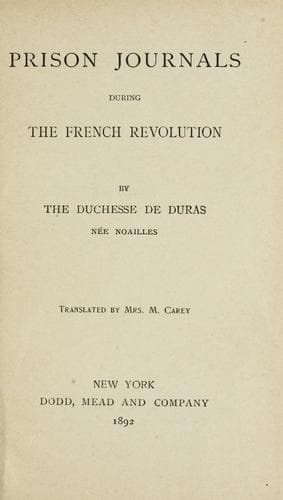
Prison Journals During the French RevolutionDuras, Louise Henriette Charlotte Philippine (de Noailles) de Durfort, duchesse de
History
Prison Journals During the French Revolution
Duras, Louise Henriette Charlotte Philippine (de Noailles) de Durfort, duchesse de
France -- History -- Revolution, 1789-1799 -- Personal narratives
Near the old village of Picpus, now a part of the Faubourg St. Antoine,
under the walls of the garden which belonged to the canoness of St.
Augustine, in a bit of ground not more than thirty feet in length,
repose thirteen hundred and fifteen victims beheaded at the Barrière du
Throne between the 26th Prairial and the 9th Thermidor in the second
year of the Republic.
Widows, orphans, and mothers left comfortless, and without support,
swallowed their tears in secret, and dared not even ask for their dead
the right of burial. In times like those, tears had ceased to be
innocent, and the tomb to be a refuge. These unhappy creatures
contented themselves with commending the remains of their loved ones to
Him whose eye is ever upon the living and the dead; but they knew not
whose hand buried them, nor even the spot of earth where they were laid.
But a Sister as brave as she was tender, Madame Amélie-Zéphirine de
Salm-Kirbourg, Princess of Hohenzollern, sister of Frédérick, Prince of
Salm, gained from her great grief a strength which others seemed to
lose. She had, I may say, watched over the last moments of her
brother's life, had seen the blow which ended his days, the wagon which
bore away his remains, the earth which received them. She bought the
spot of ground, scarcely sufficient to cover the victims who had just
been buried there; she had it enclosed by a wall, and she protected it
from profanation, hoping that pious sorrow would some day consecrate
these new catacombs. This prayer of fraternal piety has been heard; it
has been fulfilled by two sisters, Mesdames de la Fayette and de
Montagu, worthy imitators of such an example, for they were themselves
worthy of setting it. They both belonged to one of those patrician
families which had remained sound in the midst of an age despoiled of
virtue, like an obelisk in the midst of a desert; both were daughters,
granddaughters, sisters, and were related to and nearly connected with
several victims beheaded at the Barrière du Throne. One of them, whose
days were fewer than her good works, died last year, leaving in the
world, in which she has lived only to be wife and mother, a void
difficult to fill; the other, with a broken heart, a worn-out body, and
her fortune all lost, still finds comfort for the sorrowful, solace for
the suffering, and help for the poor. These two noble and pious women
began by purchasing a portion of the ground belonging to the nuns; and
upon the ruins of the cells they have caused to be built a modest
oratory. The innocence of the former occupants must help to make
effectual the prayers to be offered there. The august symbol of our
redemption has now been placed above this funeral enclosure; a priest
has been sent there by the Grand Vicars of Paris; an annual service has
been appointed there; and the blood of a Divine Victim has been offered
upon this altar for the repose of the souls of all these distinguished
dead.
Public-domain text, read in full here on John Shaqi.
Reviews
Reviews
No reviews yet
Be the first to share your thoughts on this work.
Elsewhere in the archive
Join the Discussion
Join the discussion
Sign in to leave a comment or review.
Sign InorCreate an account